
Like this? Follow me:
The Gossamer Gear Grit 28 At A Glance
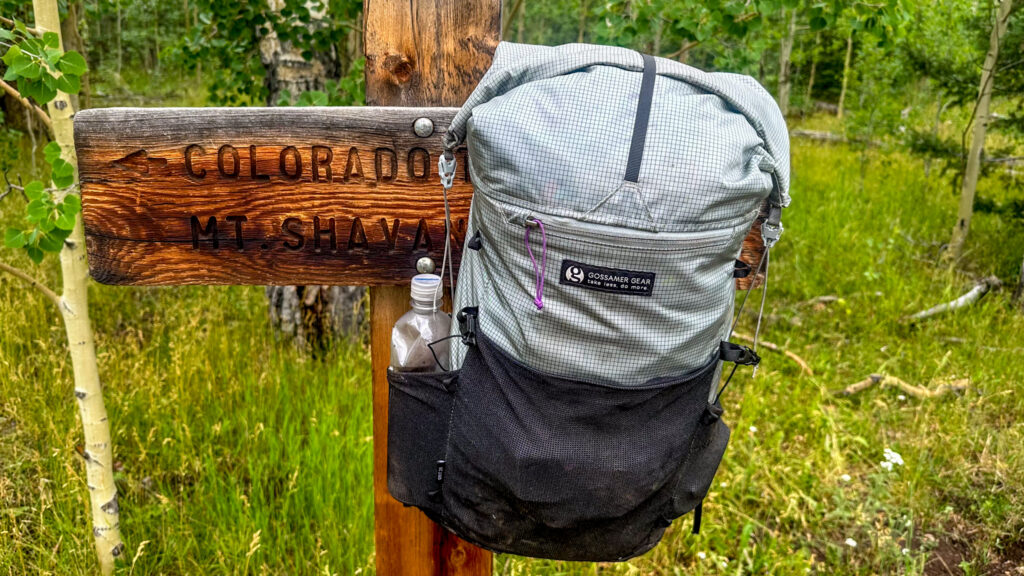
The Gossamer Gear Grit 28 is an absolute exemplary fastpack for super ultralight pack outs where long days, miles, and pushing your limits is your primary goal.
Stand Out Features of the Gossamer Gear Grit 28
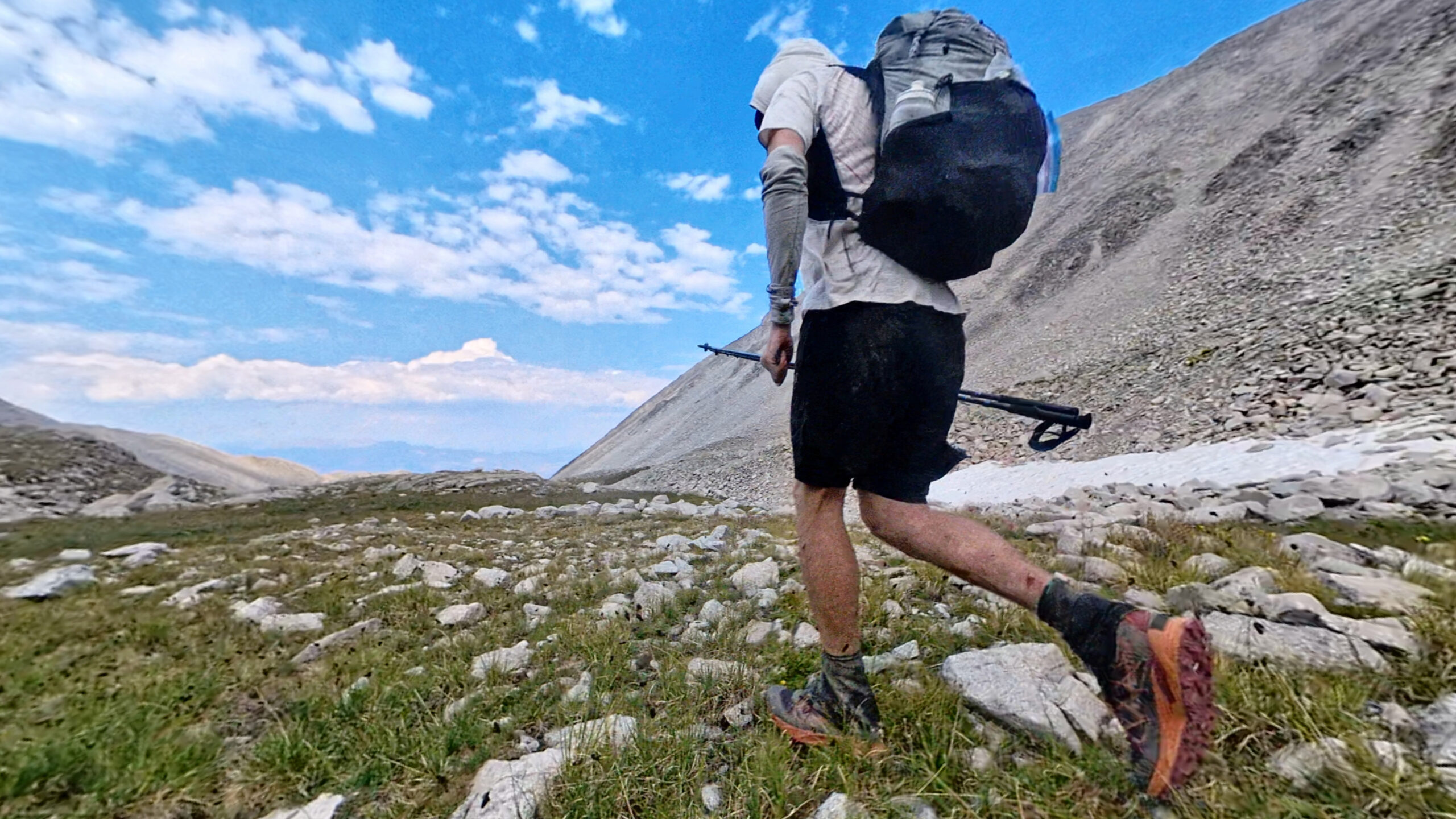
The excellent value for what you pay, the Grit 28 is affordable when compared to many of similar products from other companies, well staying performative. The secret may lie in the pack material: the 100D recycled ripstop Robic nylon is both featherlight and tough, while also being much less expensive than more exotic Challenge Ultra or Dyneema composite materials of its competitors.
The surprising amount of interior space that’s far north of 25 Liters, allowing you to carry a compact kit and many days of food. Coupled with the pack weight of approx. 459 grams, the Grit 28 packs a ton of volume for its weight. This is neither a running vest your trying to smash all your gear in, nor is it a thru-hiking pack with too much volume. Rather, this is specifically made for fastpacking load outs.
The exterior pockets and use of UHMWPE Stretch Mesh, providing many useful places to put gear and have it stay in place without flying off while you’re flying down a mountian.
The foam padded, running vest inspired shoulder straps, replete with pockets up front, and double sternum straps.
The removable back padding that’s easy to deploy for a sit pad or to use under your back for a quick nap, mid FKT-crushing, or to leave at home to save more grams.
Gossamer Gear design motifs everywhere. If you already have a Gossamer Gear pack like the Gorrilla or Mariposa, this pack will feel right at home with many of the same design cues.
Details of the Gossamer Gear Grit 28
- Weight: Total: 16.2 oz / 459 grams
- Pack body: 14 oz / 397 grams
- Back padding (removable): 2.3 oz / 64 grams
- Volume: Total: 28L (as per manufacturer)
- Internal Volume Measured: 28L
- Pack Material: 100D Recycled Robic Ripstop Nylon
- External Pockets:
- 1x center, holds gallon Ziplock
- 2x side, holds 1x smartwater bottle/each
- 1x small center zip pocket (not waterproof)
- Vest Pockets:
- 2x water bottle/flask pockets, can hold hard cycling water bottle, smartwater bottle, soft flask
- 1x zippered pocket
- 1x small open pocket
- Running vest-inspired shoulder straps
- double sternum straps
- Frameless
- Hip belt-less
- Removable foam back pad
- Hydration Bladder-compatible: small opening + looped tab to hang bladder
A Tour of the Gossamer Gear Grit 28
At first blush, the Gossamer Gear Grit 28 looks fairly inconspicuous and you could mistake it for a day pack. This is a consequence of Gossamer Gear’s “Keep It Simple” attitude to pack design in general, as well as the design language developed and used throughout the Type II Collection.
Its simplicity is one of the Grit 28’s major strengths, unneeded features are simply not found on this pack. Gossamer Gear also started out thinking “backpacks” and made them more compact, rather than thinking, “trail running vests” and enlarging those and that does reflect on the end product, which looks a little more boxier like a pack than a curvier high capacity running manufacturer’s pack. Save for the roll top rather than flap, if you enjoy other packs from Gossamer Gear, things are going to feel very familiar to you in the Grit 28, only shrunk down.
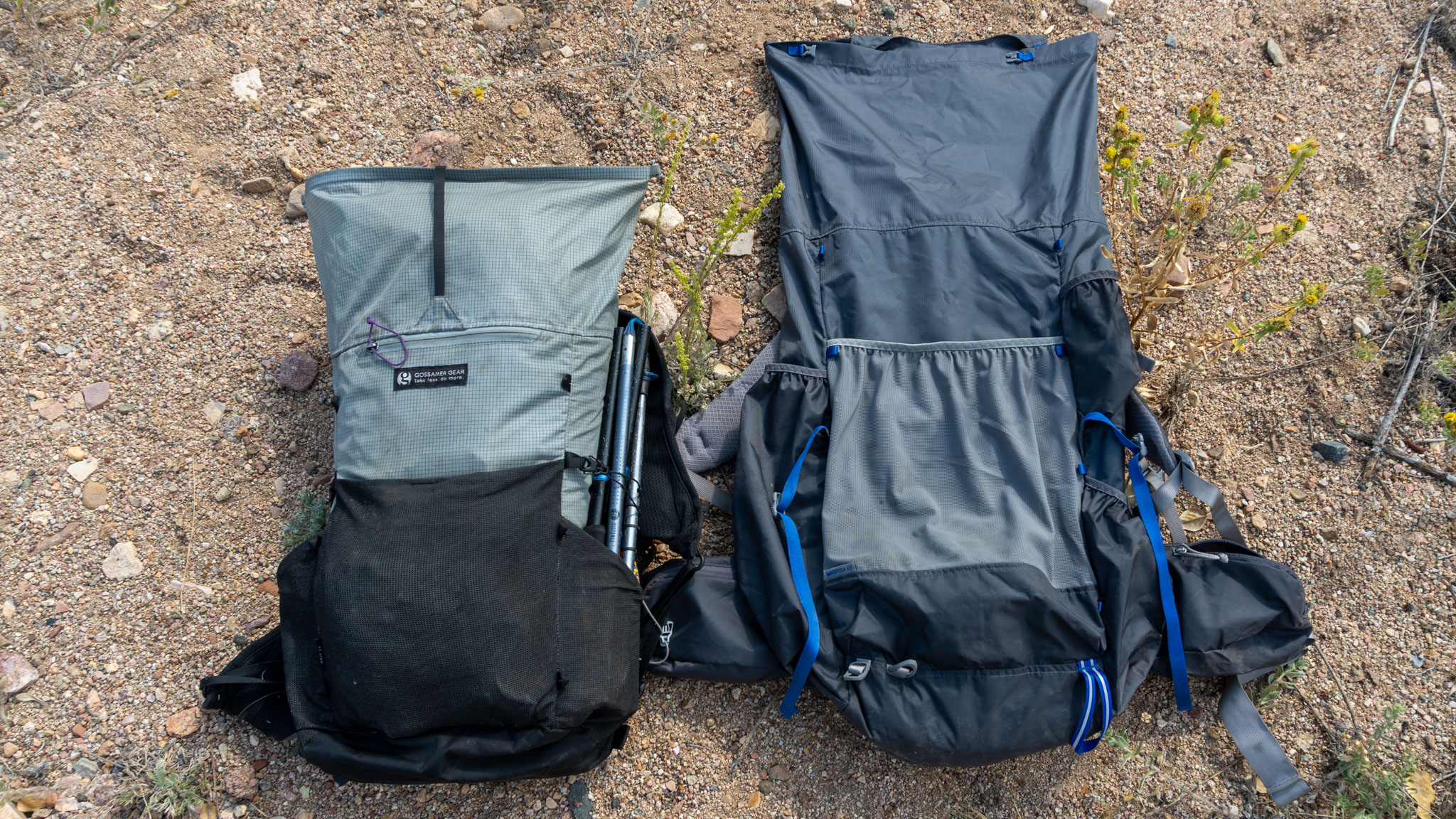
Main Pack Material: 100D Recycled Ripstop Robic Nylon
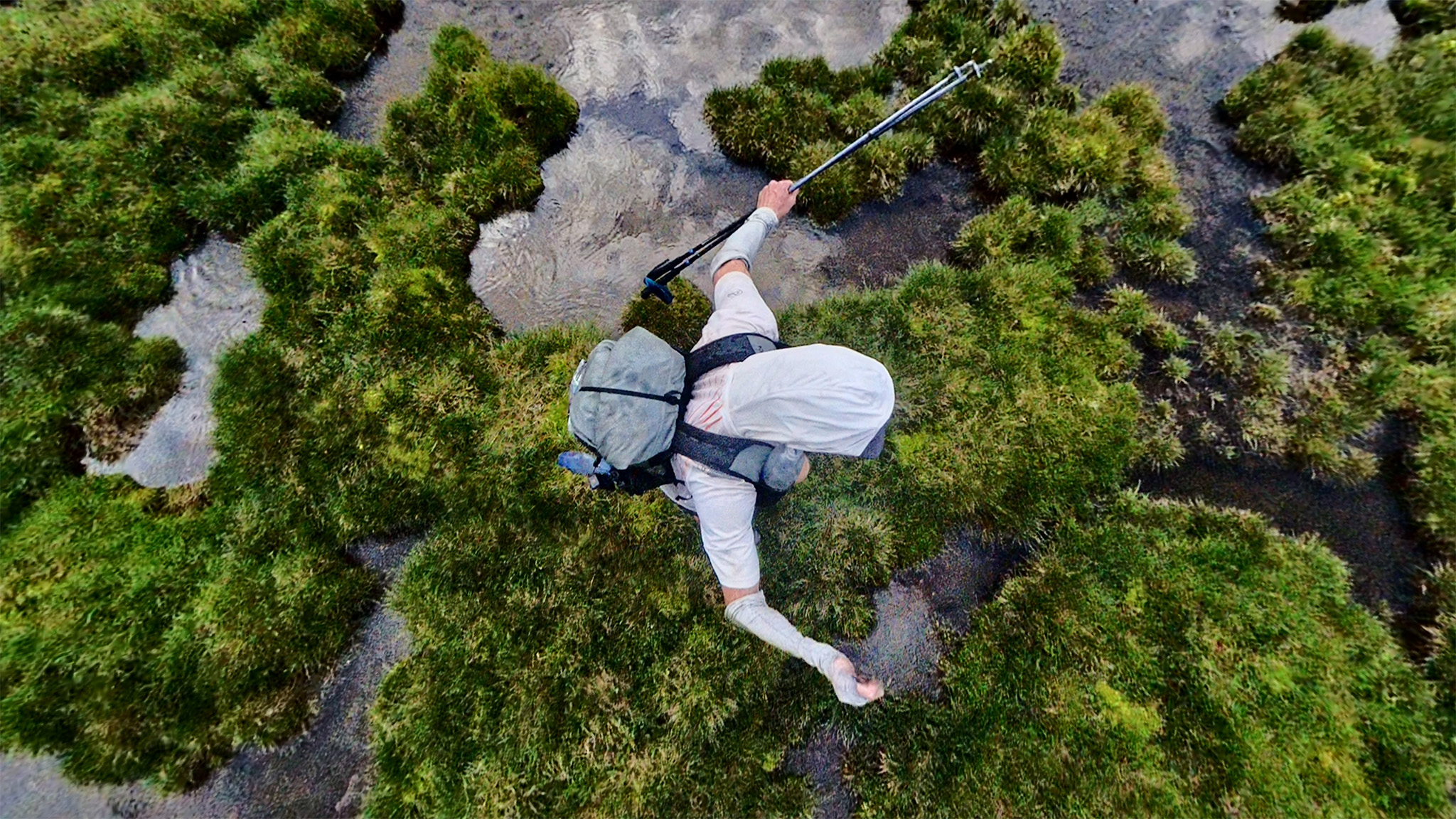
The main pack material of the Grit 28 is a flyweight 100D ripstop nylon. Surprisingly, I found this material to be durable enough even for a klutz such as myself to take on-trail, as well as off-trail. I’ve used this pack for run commutes, gym work (weights in the pack!), a Colorado Trail Collegiate Loop FKT attempt, Nolan’s 14 recon missions, and quite a few things in between. I have not been kind to the Grit 28, and after 20 hours of nearly constant movement, I forget my manners and forget to treat anything with kids gloves.
After an almost entire summer, I have not noticed any rips or tears. There are much more expensive and exotic options available competing with this more conventional ripstop nylon, but much like the rest of Gossamer Gear’s lineup, they’ve stuck to the tried and true. This has turned out to be a great idea, as you’re getting a quality product, without having to get a second mortgage on your home just to temporarily live out in the forest. I would go so far as saying that this material is an upgrade to other packs Gossamer Gear produces outside of their Type II Collection, being it seems more durable and a little lighter. It will be interesting to see if they move more products towards it.
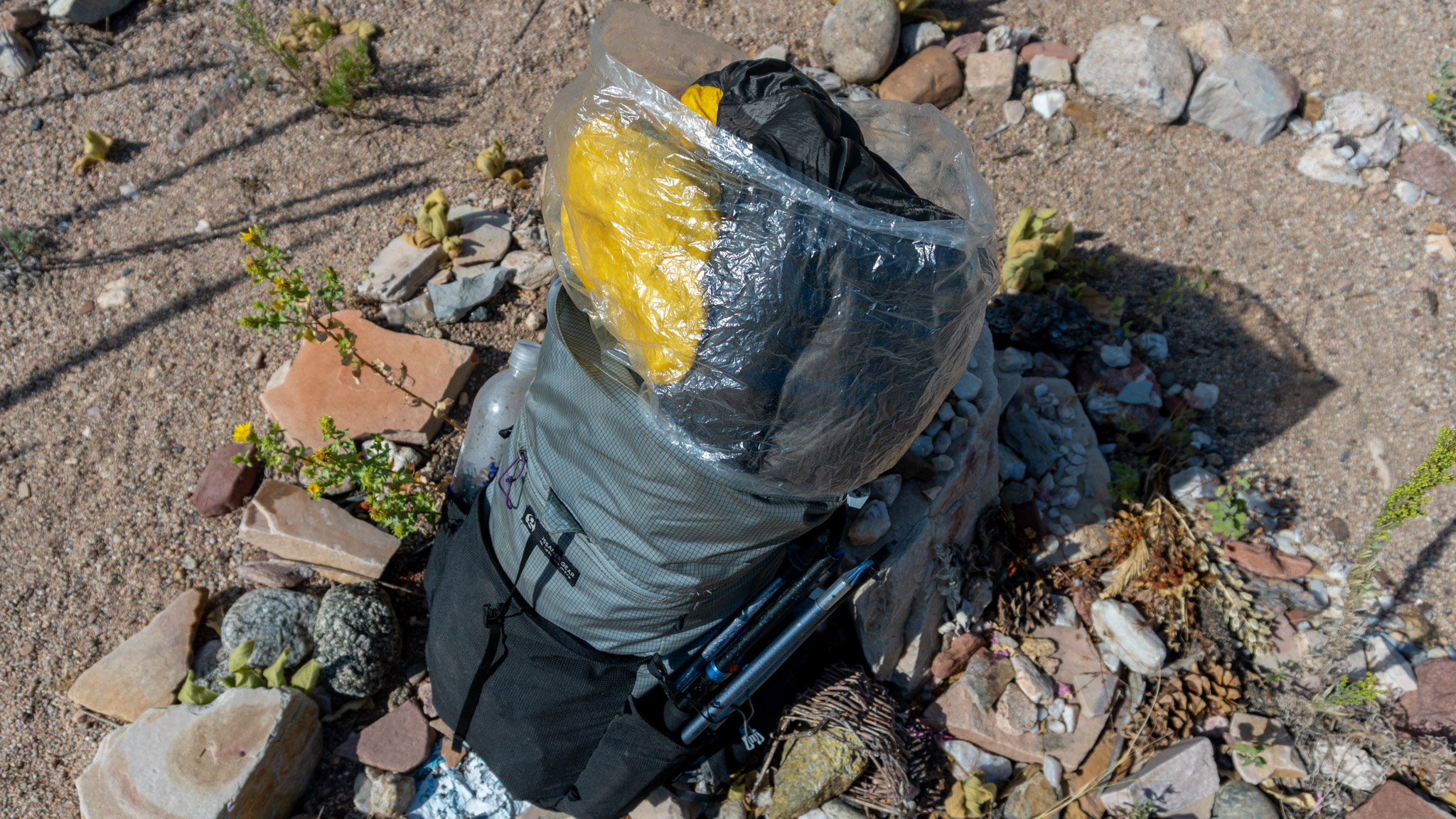
The only consolation that you lose out with 100D ripstop nylon is water resistance: if it rains, your gear inside could get weight. The fabric is so thin it will appear translucent when wet and you may be able to make out the shape and color of your gear inside! Likewise, when you sweat — especially if you’re like me and use this pack without its included back padding — it’ll come through the back.
For that reason, grab an inexpensive and reusable pack liner and have it at least available in the bottom of your pack. If you get slammed by surprise hail storms like I have, it may save your trip from having a night spending in a soggy sleeping bag. A pack liner will add about 34 grams to your base weight, but will stop you from needing to bring along any other waterproof bags with you, so altogether it’s a win to utilize.
Internal Compartment: > 25L
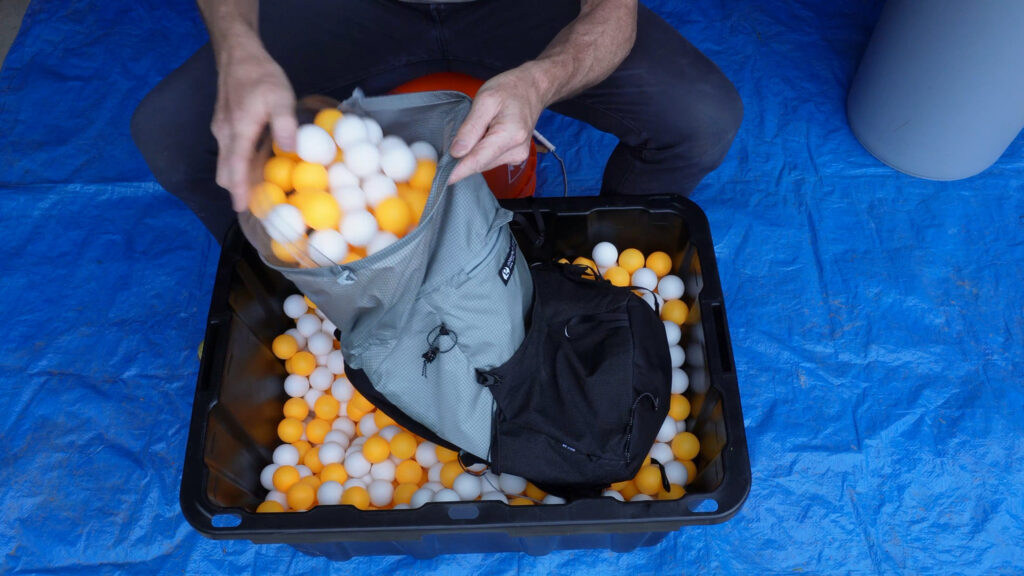
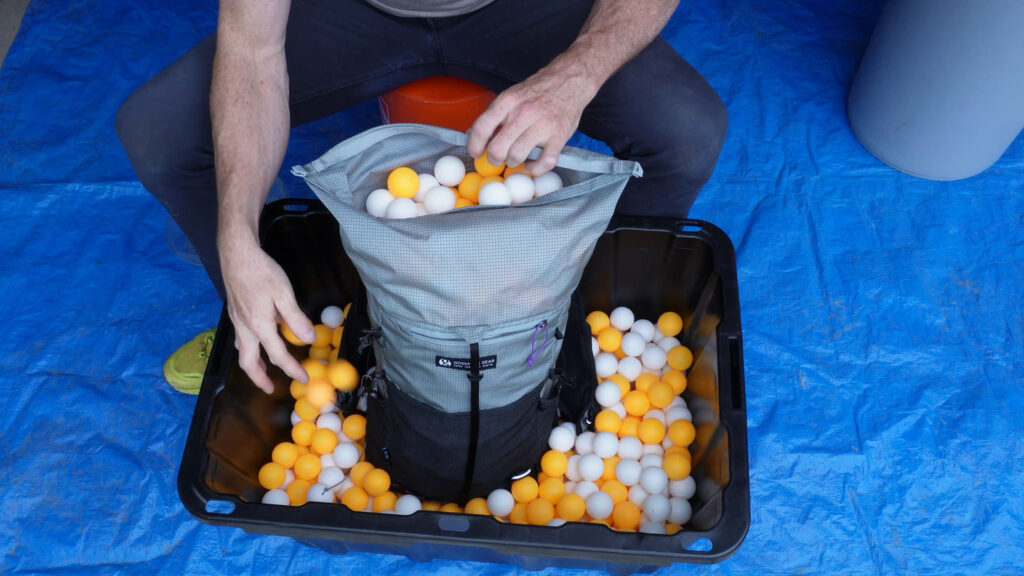
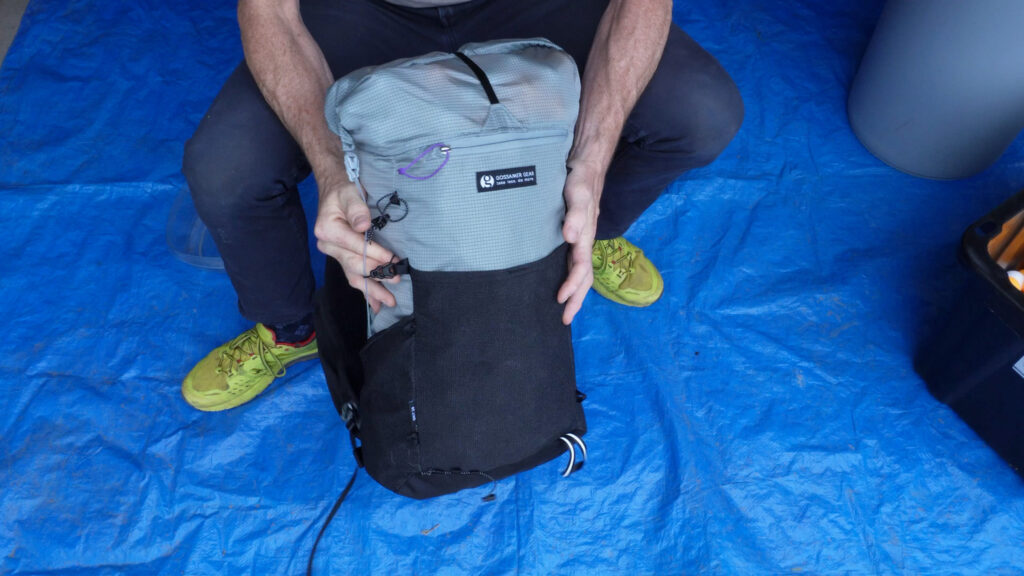
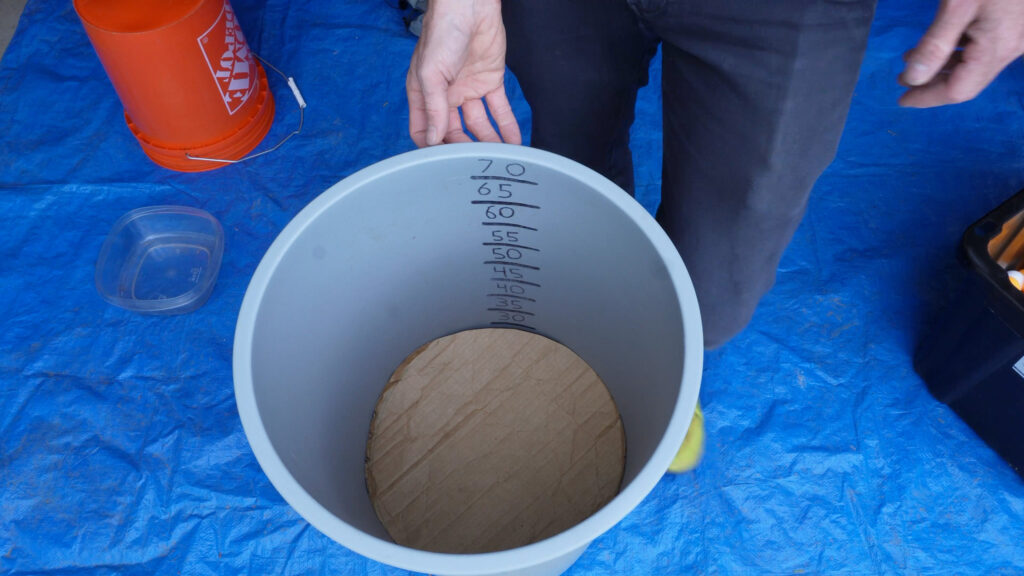
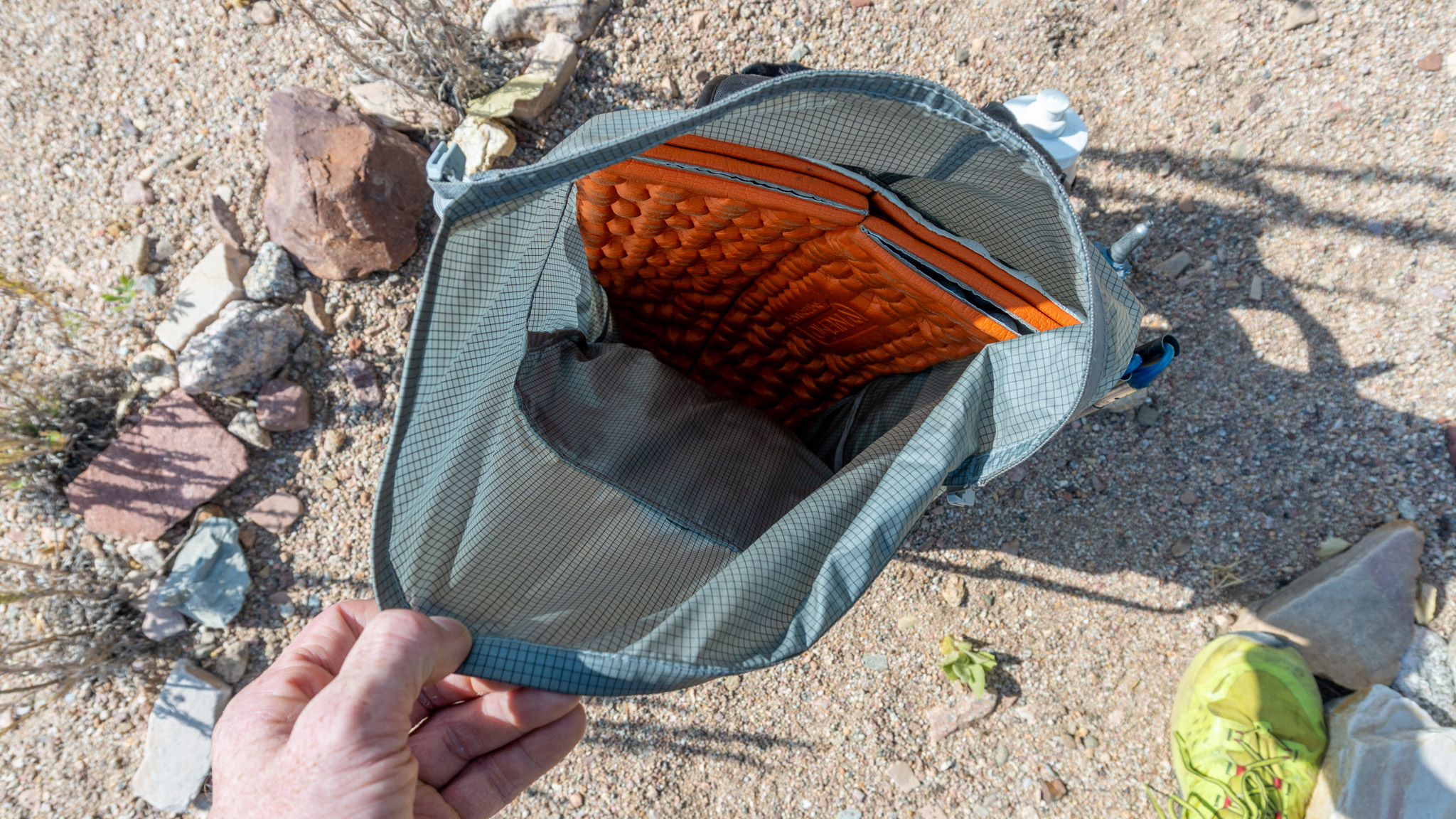
The main pack compartment is one large volume without any internal zippers or other accoutrements, save for a simple loop of webbing to sling a water bladder hook on (no bladder sleeve). This is excellent, as it means there is nothing in your way to stuff all your gear in however you’d like it. Storage organization? That’s up to you, but if you’re truly fastpacking, the amount of gear you’re bringing is going to be minimal as well.
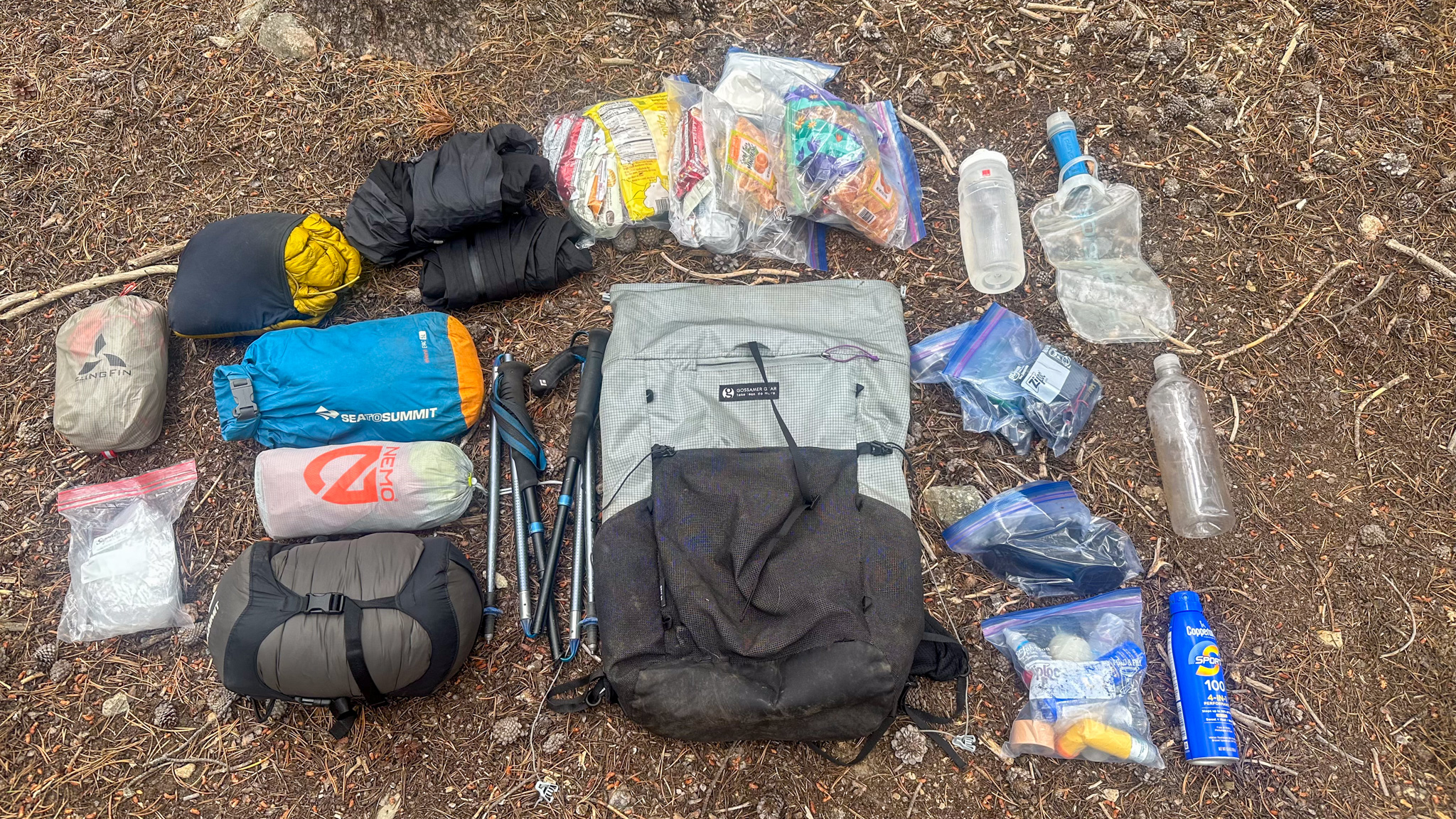
The internal volume is actually pretty impressive, as I was expecting to receive a smaller pack when ordering. I measured the internal volume alone to be 28L, which seems incredibly generous (Gossamer Gear specs. it officially at 25L). A good amount of volume is useful even for minimal-gear fastpacking applications, as it means I can stuff a full-sized ultralight sleeping bag in there without needing to first stuff it tightly into a compression sack.
This ultimately means that the bag keeps at least partially lofted up, making it far easier and faster to deploy as well as put away once done. When I’m taking naps that are 20 minutes long, every second I can save matters and can translate to time I can close my eyes. A sleeping bag or quilt let free in a pack also does a great job in helping keep jostling items at a minimum as the ever expanding down will naturally take up most any empty space. I’ve found the internal capacity also enough to pack along a closed cell foam pad (4 or 6 panels) inside the pack as well.
Roll Top Closure
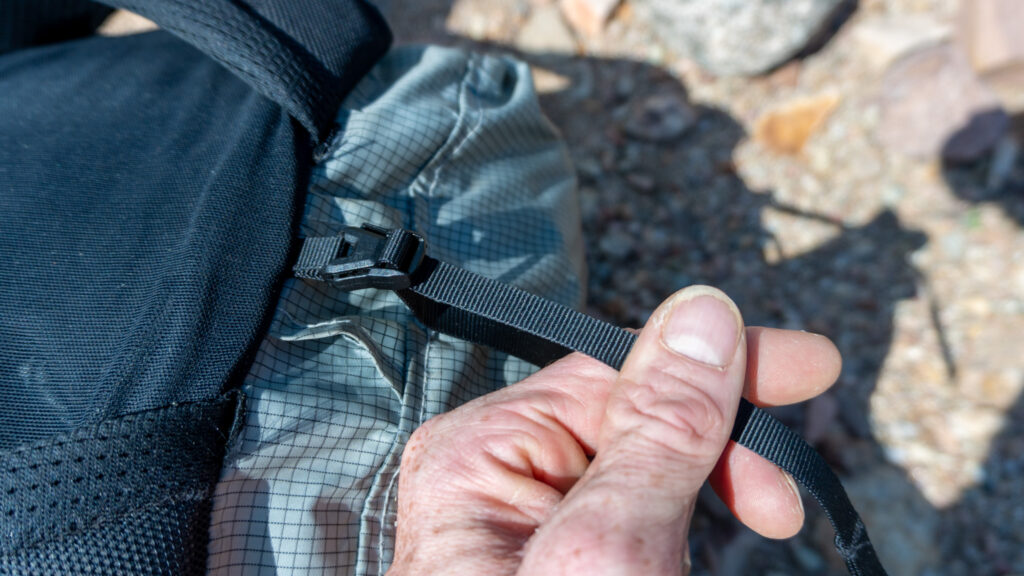
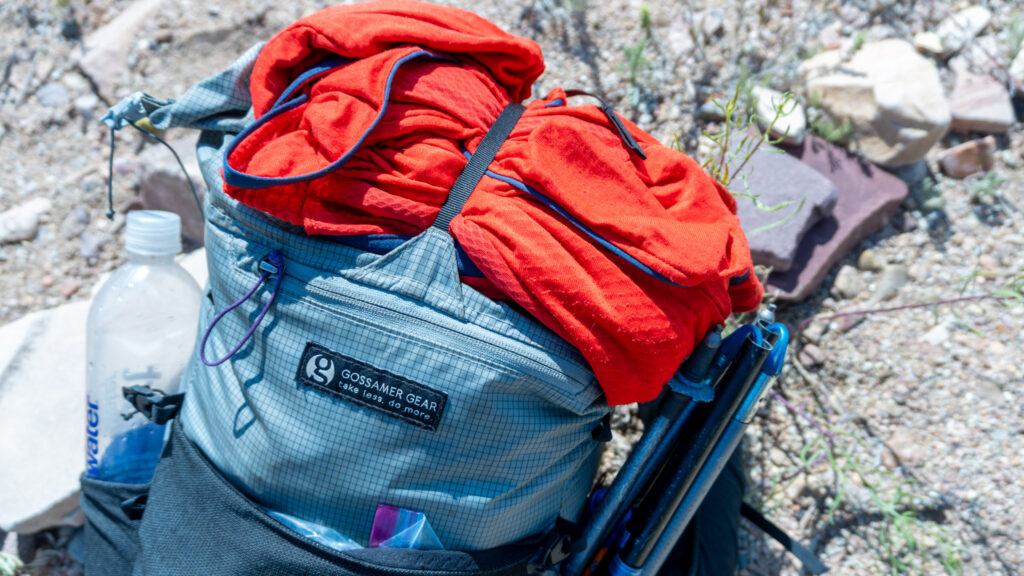
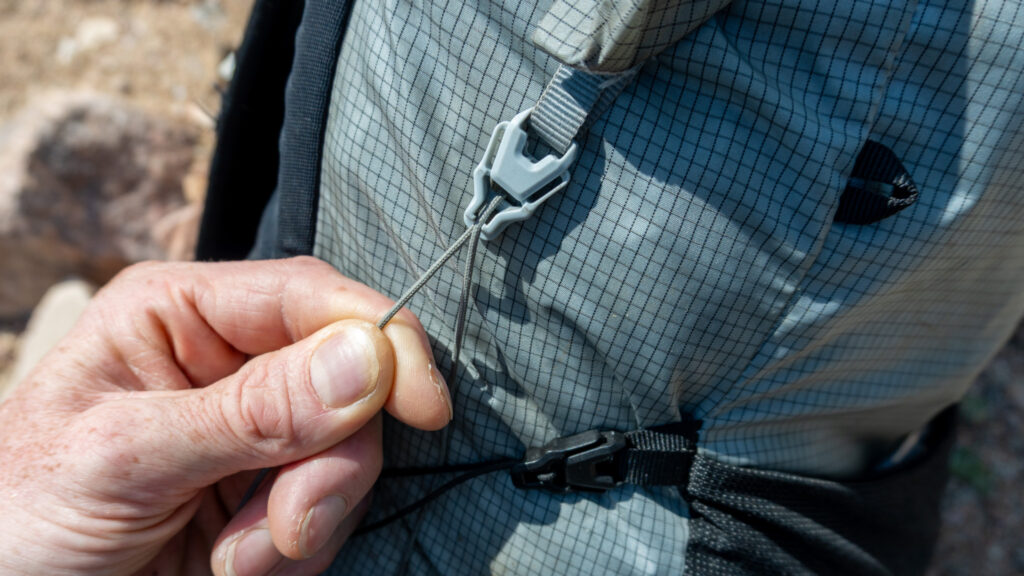
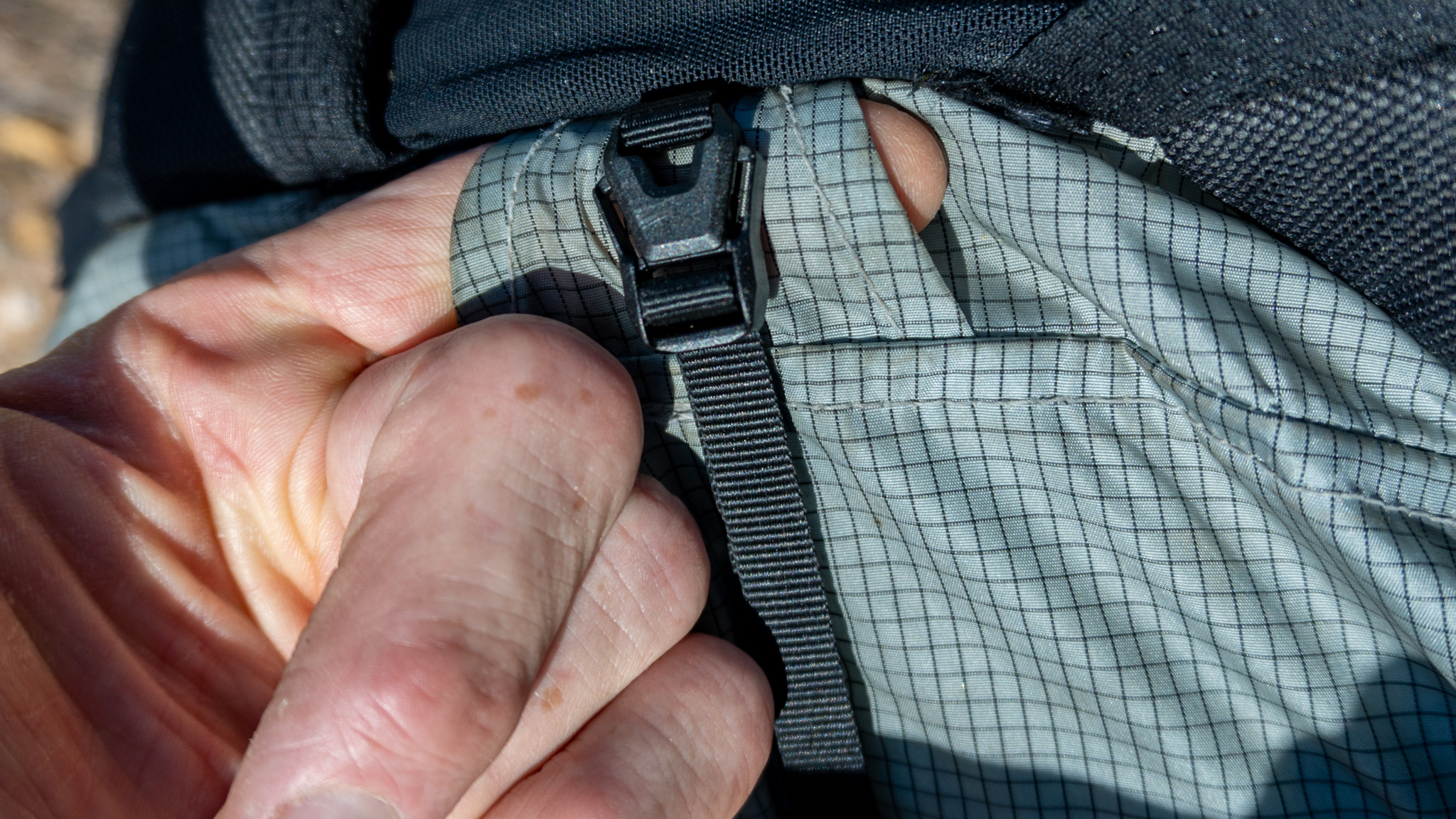
The Grit 28 features a roll top closure, which makes it easy to compress your gear down to prevent the jostling of items inside — especially important when you’re running. The rolled down top is secured using two very small buckles that look similar to ones you’d find at the corners of your favorite ultralight tent, as well as a small top strap that goes over the pack from front to back. There’s not going to be enough length of the top strap to secure much more than your jacket to the top — let alone a bear canister — so think of it as some insurance for your roll top to not unroll on itself.
Exterior Pockets: UHMWPE Stretch Mesh
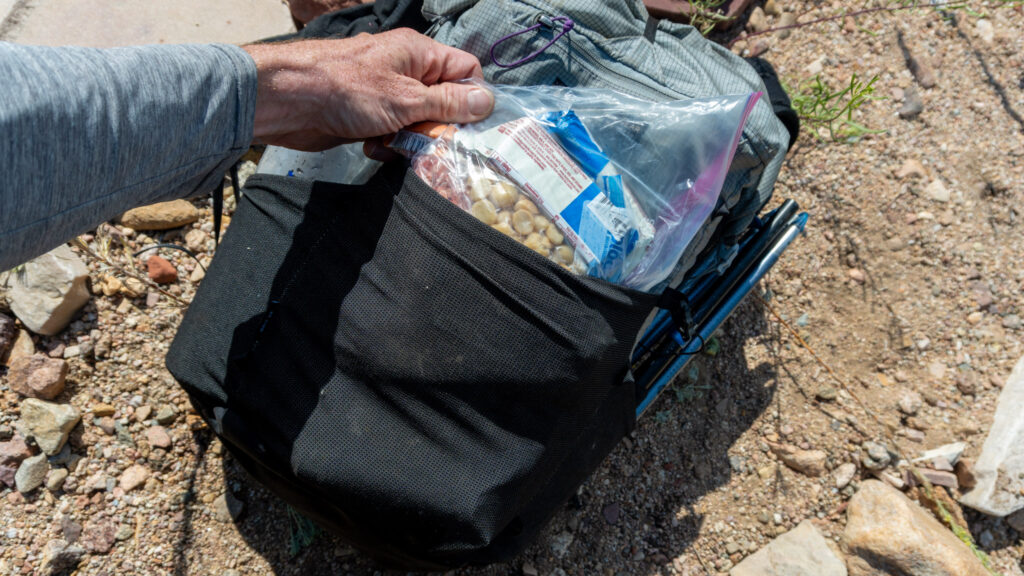
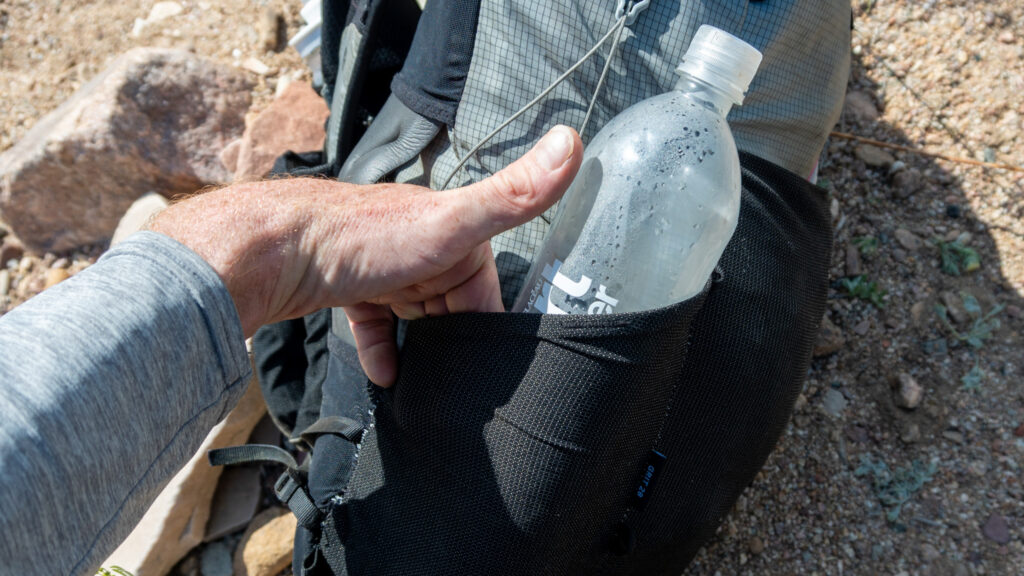
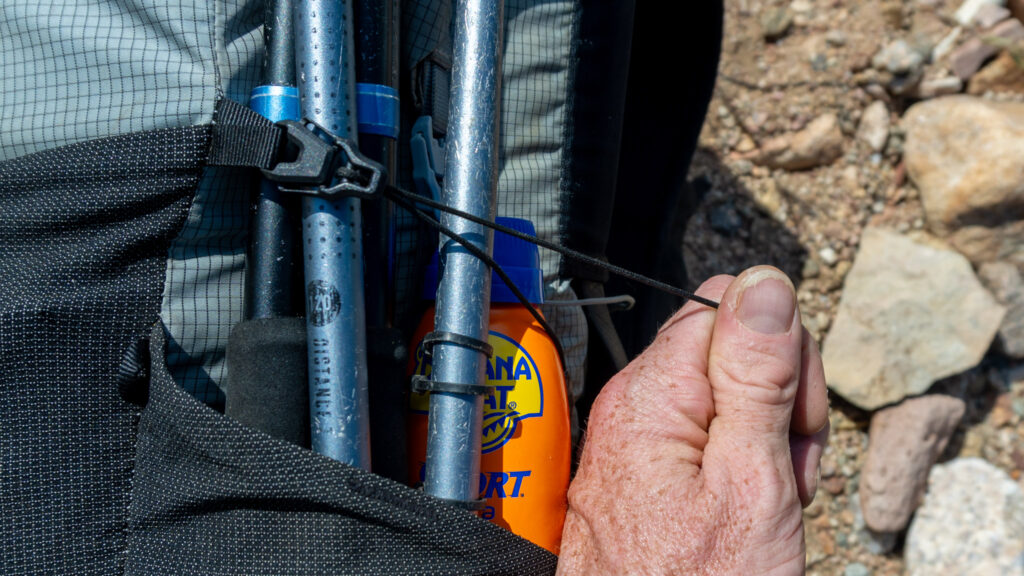
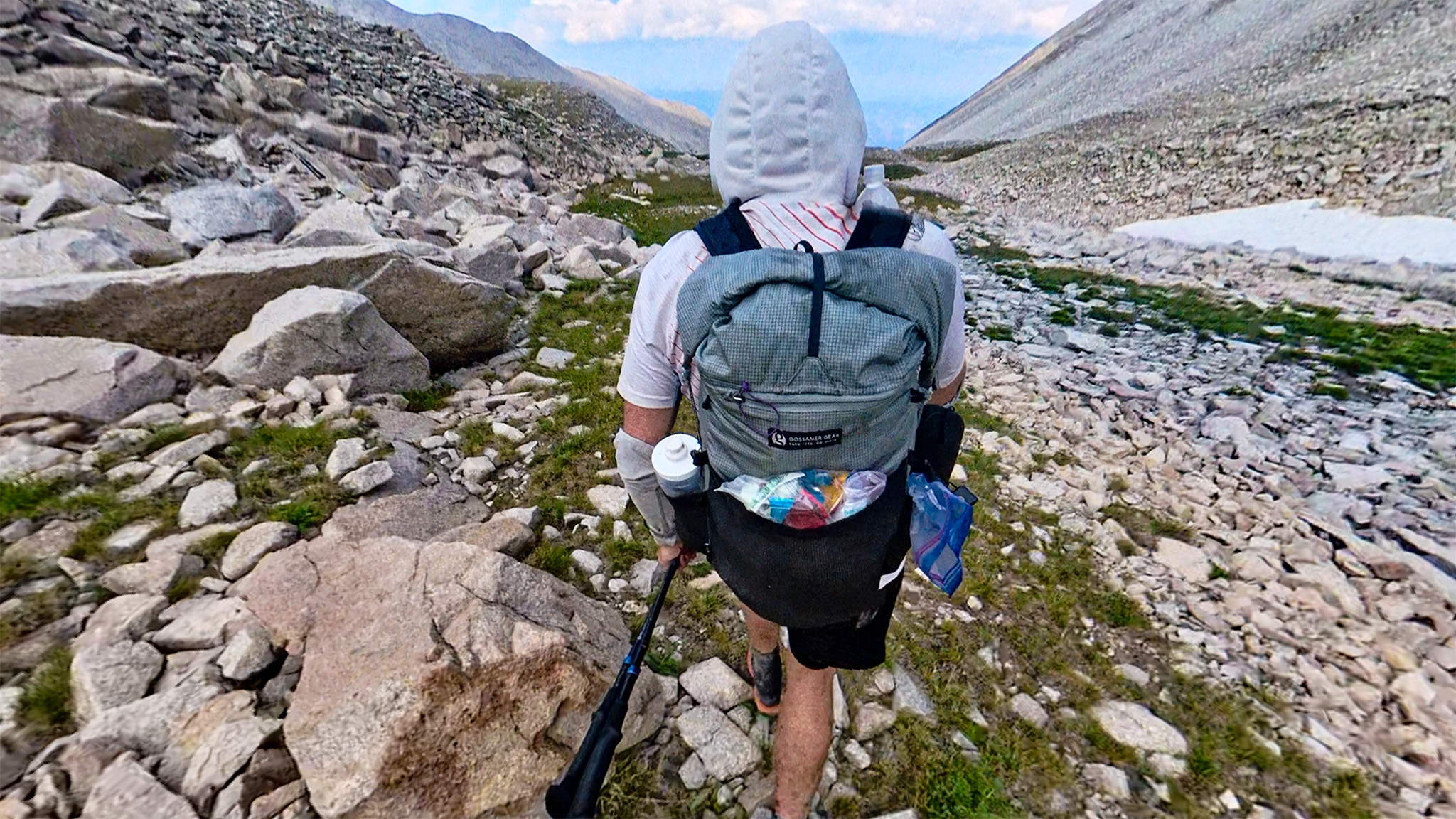
On the exterior of the Grit 28 we’ll find a large center, a small center zip, and side pockets. Much like the rest of the pack, they’re smaller than what you’d find on a full-sized backpack. Plan to be able to fit about a smartwater-sized container in each of the side pockets, and around a gallon-sized ziplock back in the center. This is a fine amount of exterior space for fastpacking. I usually have a 750ml bottle in one of the side pockets, and a collection of accessories in the other (some sort of food item, water filter, trekking pole, etc). The center pocket is where I usually try to fit in the day’s food, which conveniently also fits into a gallon ziplock bag.
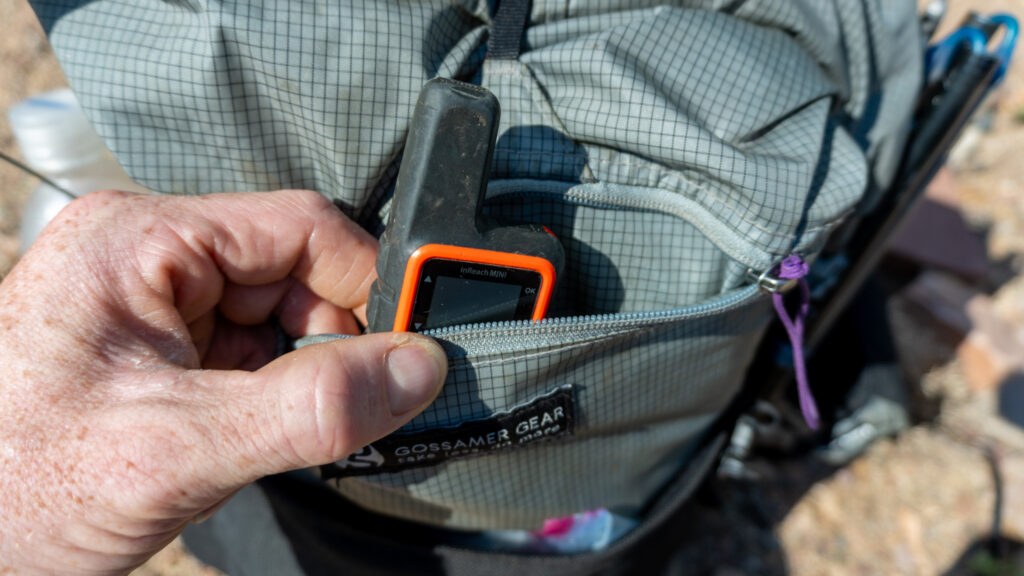
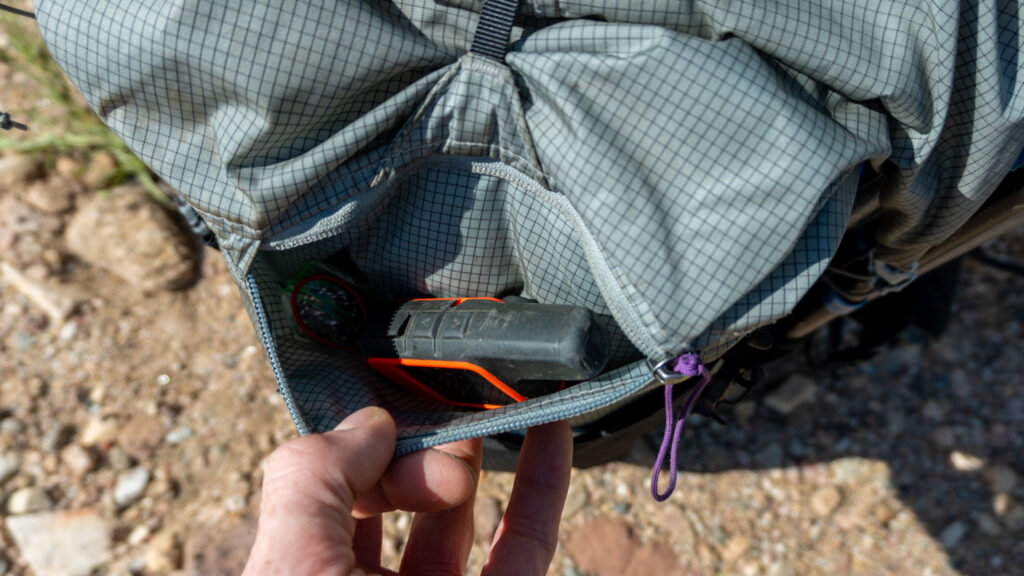
Above the center pocket is a small zippered pocket which I use to keep close-at-hand gear securely. Many of my electronics find themselves into this pocket, as does my satellite communicator.
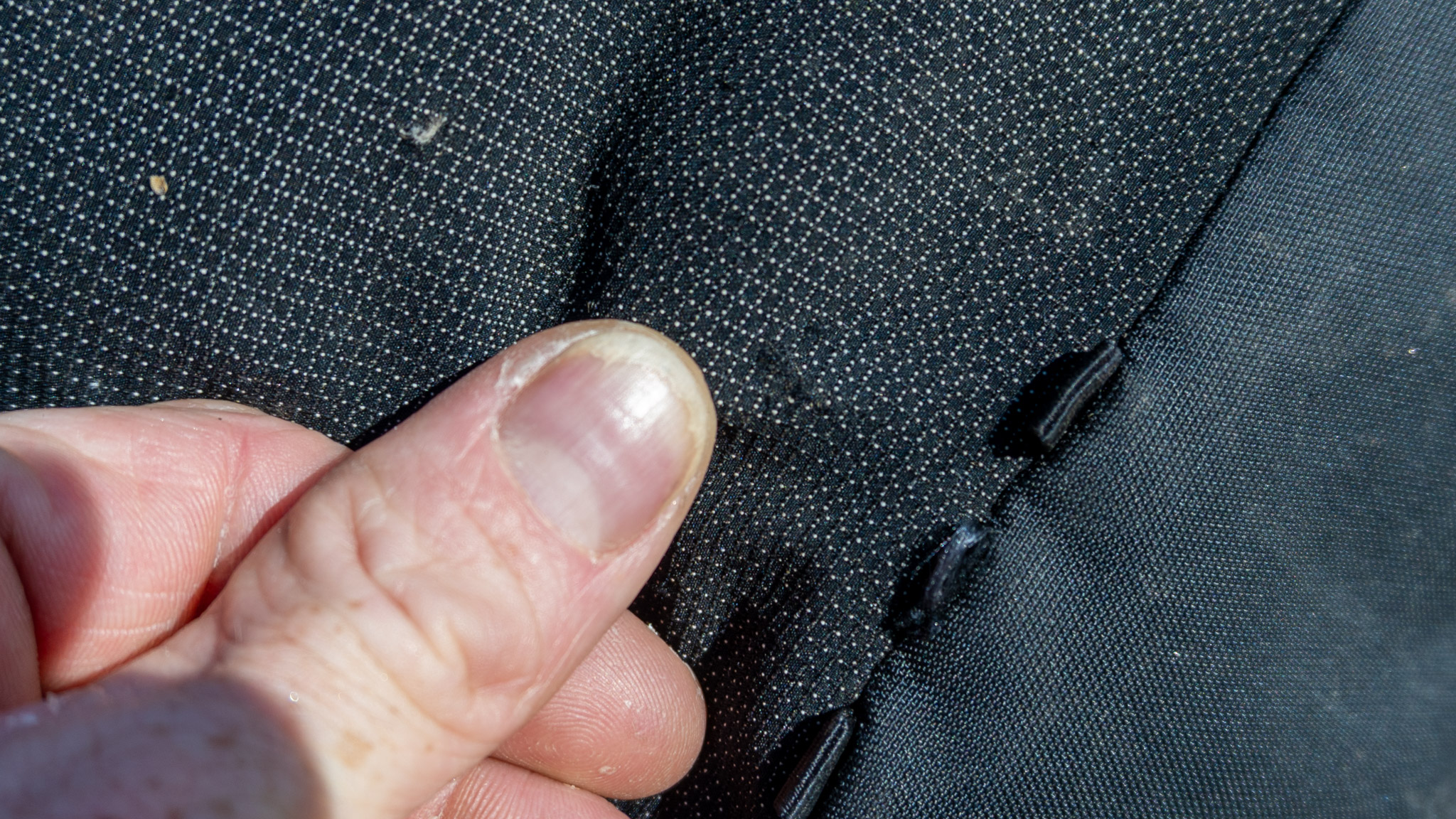
What makes these pockets exceptional is the UHMWPE Stretch Mesh they’re made out of, which is both durable and as the name would suggest: stretchy. I have found this material on many different packs I’ve reviewed and it has quickly become one of my favorite to use for exterior pockets. This stretch mesh holds onto items well, meaning I’m not worried they’ll fly out. It also means that even though the Grit 28 lacks any cinches of any sort on these three pockets, they’d be superfluous anyways. What sets it apart from other materials is that it’s also fairly durable, and these external pockets get a ton of abuse.
Running Vest Shoulder Straps
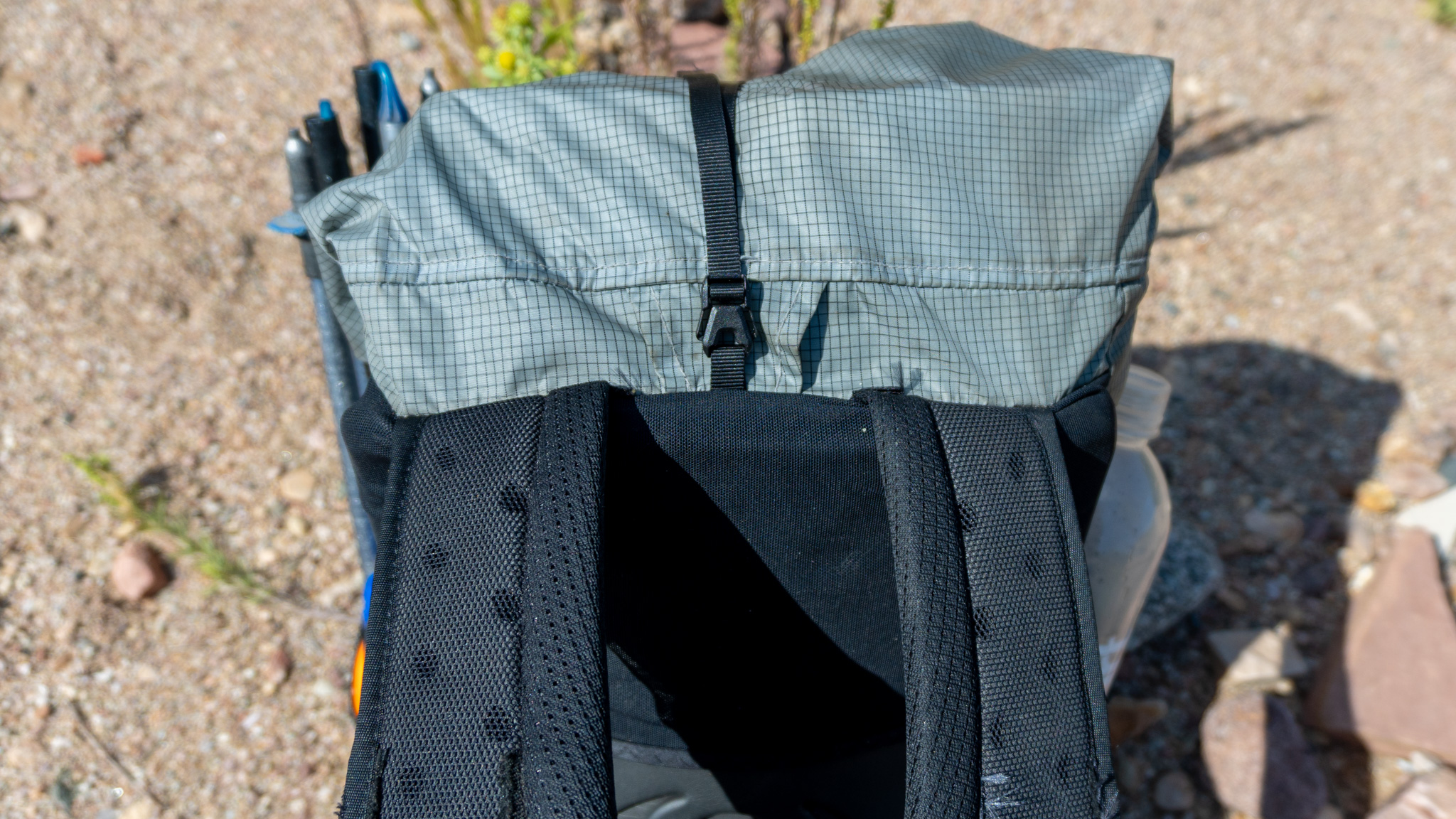
In the front of the pack you’ll find the running vest-inspired shoulder straps. Straps on top come in from the pack, rather than being a yoke design, and are relatively straight, and they’re attached at the bottom by a harness-like design where you can make adjustments. As there isn’t a frame or hip belt to take off weight from the shoulders onto your hips, all the weight will stay on your shoulders. To counteract some of that discomfort, Gossamer Gear has made these shoulder straps fairly wide and with generous foam padding. Designs like this are pretty standard for fastpacks — hip belts do tend to get in the way of running mechanics, and a higher center of gravity seems to work best when moving fast as well — and the Grit 28 does ride up high. So much so, that even though I’ve been using fastpacks for over a decade, it still felt unnaturally high to me.
I don’t always see as much padding in straps of other fastpacks than I do with the Grit 28, but it seems to work well for this pack and most likely will work well for you too — so long as you understand the limitations of the system as a whole. Fastpacking should imply a very lightweight pack weight to allow you to move fast and even run. My own base weight for fastpacking is sub 8lbs: here’s what I used during my Collegiate Loop FKT attempt. With 8lbs of food, and a few pounds total of water, my absolute maximum carrying weight at any time is 20lbs. You can push this slightly more, but in reality it’s hard to do, as there is just so much volume in the Grit 28 (carrying gold bars notwidthstanding).
It does take some getting used to, so if you’re buying this pack, make sure you’re all-in or you’re not going to be happy with how this pack carries and you’d be far better served for multiday trips with an actual ultralight backpack, which Gossamer Gear has a wide selection of. Of course so long as you keep it 20lbs or less, it doesn’t matter what you bring. 2lbs of food and 18lbs of everything else for a quick out and back overnight? Grit 28 would be great.
Harness-style shoulder strap adjustments are found in the bottom of the straps themselves, and there is a generous amount of webbing length to accommodate most body types. I’ve cut these straps down myself as they do get a little annoying flapping around free in the wind. I didn’t experience any loosening while wearing this vest: once set, they’re going to stay where they are. They aren’t the easiest to adjust on the fly, so my suggestion is to get things dialed in before your trip.
Front Pockets
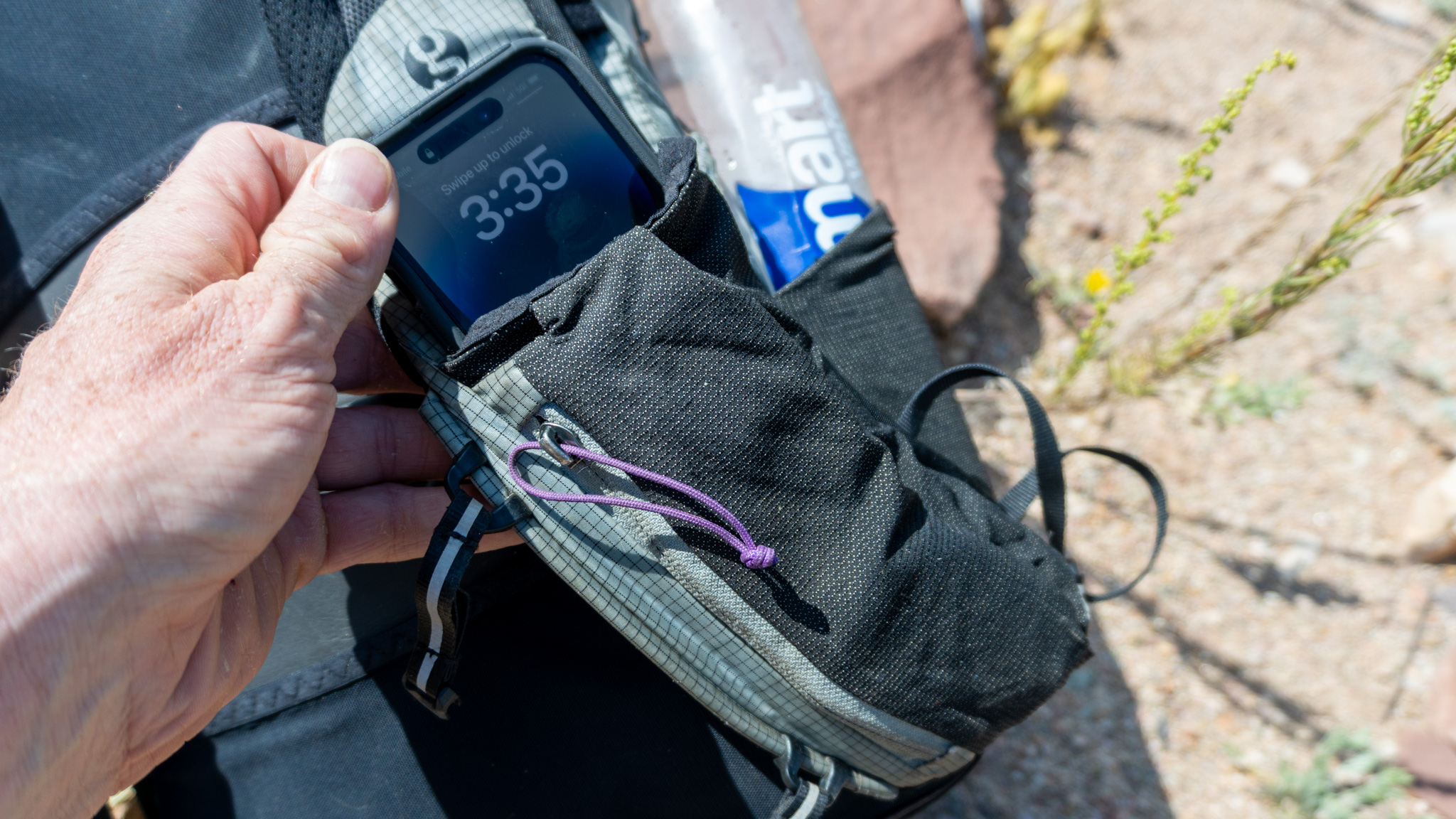
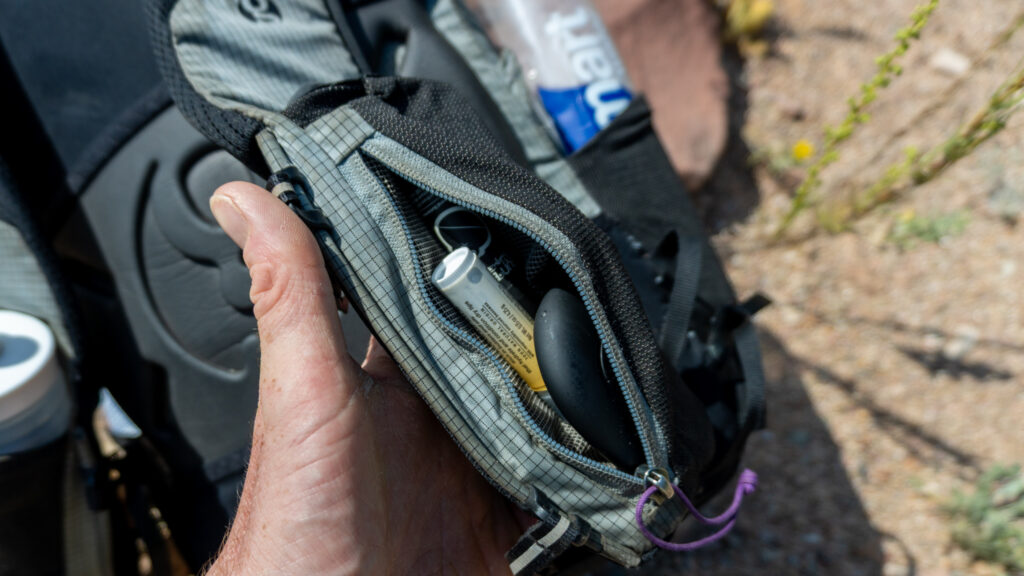
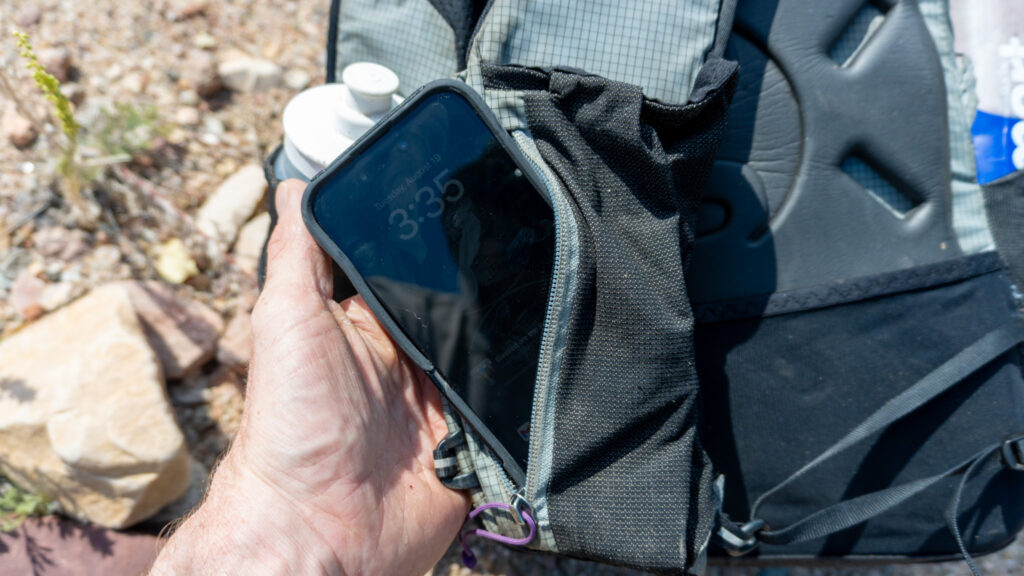
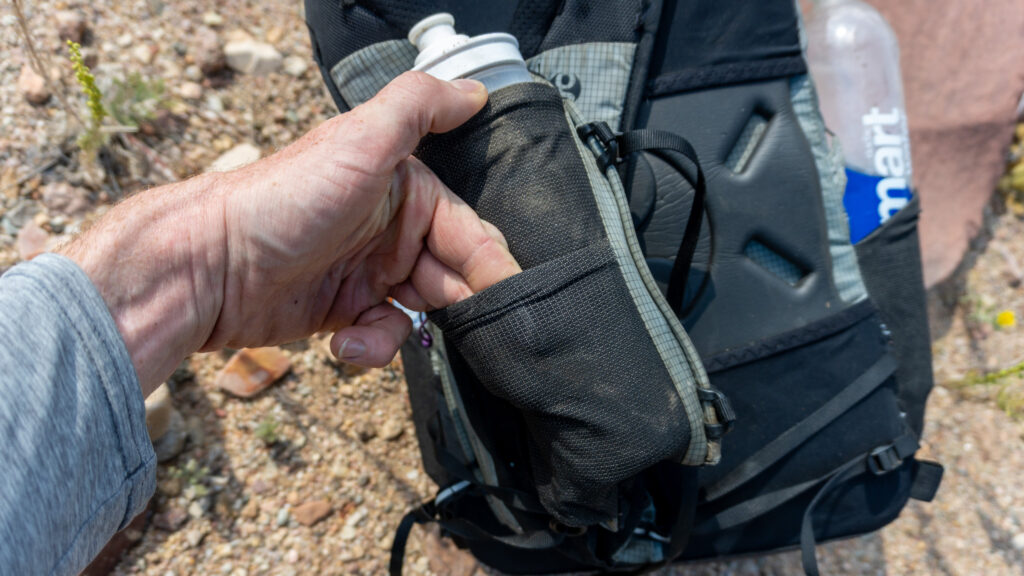
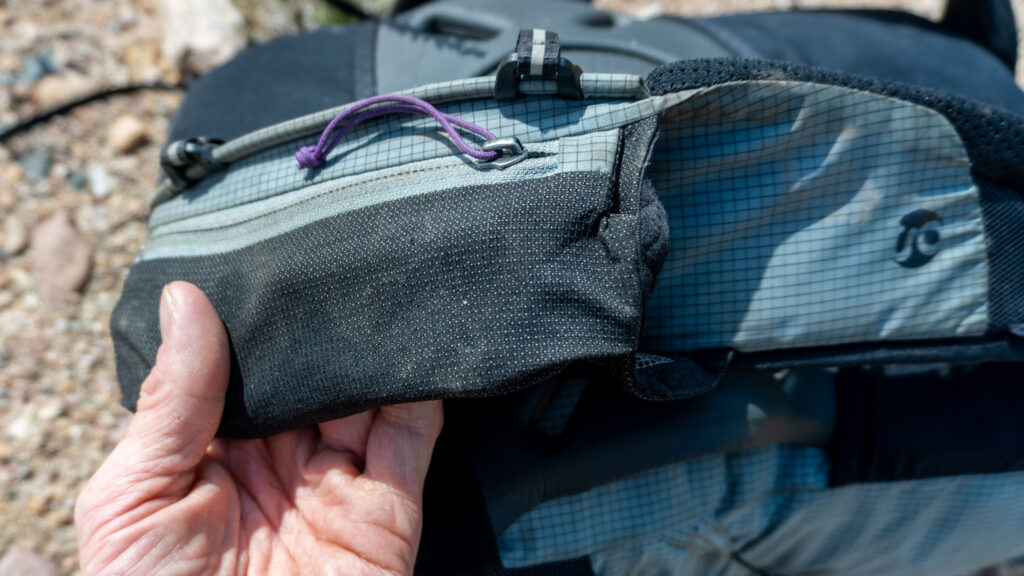
On the front of the shoulder straps are found a total of four pockets made of that same excellent UHMWPE Stretch Mesh. Two of these pockets are designed with a generous volume and an open top, perfect for water bottles or flasks. These two pockets also feature cinches to help close them up. I use the left one myself to carry my phone, as the open top let’s me pop it out and back in easily, while the stretch mesh keeps a friendly hold on it, even when the pack is inverted.
The left shoulder strap also has a zippered pocket for small accessories. It’s somewhat divorced from its neighboring pocket in back of it, which facilitates packing up more items without having it interact with say, a hard water bottle poorly. I usually put in a small dropper of hand sani, chapstick, maybe some sunblock, and a snack in this pocket for quick access. Although I can force in my phone — a iPhone 14 Pro w/case — into this zippered pocket, it’s not easy to do. I wish I could perform this more easily as it would free the left open pocket for more water carrying, but alas. If you have a smaller phone, you may have better luck.
The right shoulder strap has another, much smaller open pocket, but without a lot of internal capacity. If I am also carrying a water bottle, I find this pocket hard to access as its sewn tightly to the contours of the pocket in back, so it’s mostly used by me to carry wrappers temporarily. In general, I love shoulder strap pockets, and would love to see even more, but the three very usable pockets on the Grit 28 are more than adequate for my fastpacks.
Foam Back Padding
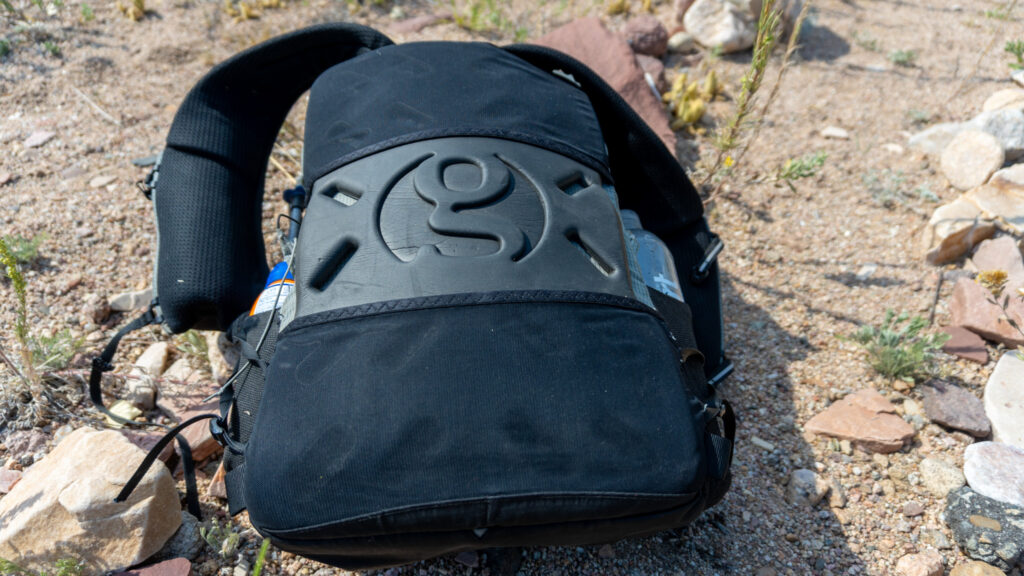
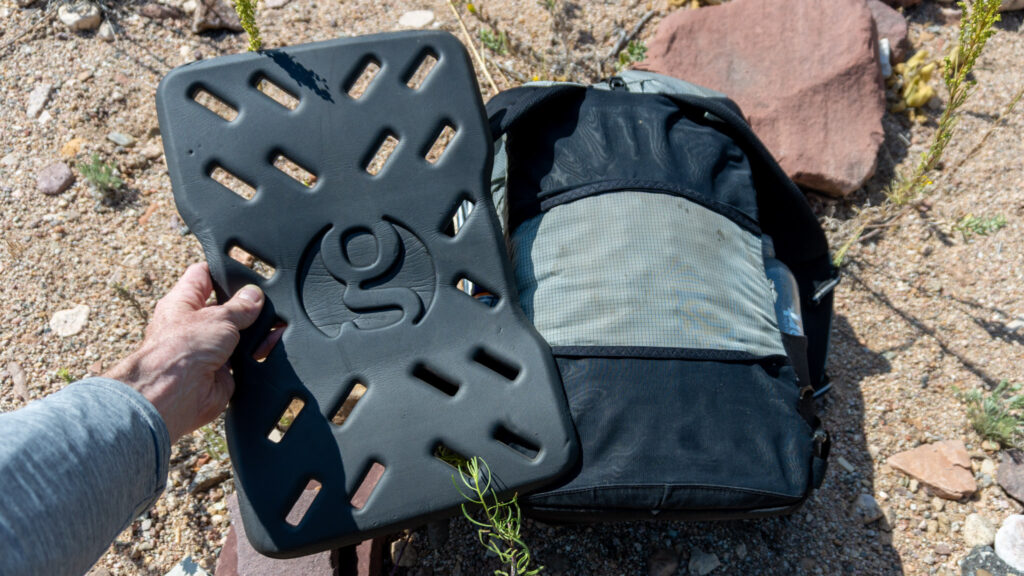
In the back of Grit 28, you’ll find the foam back padding, located in a dual sleeve on the exterior of the pack itself. This provides adequate padding against anything sharp in the pack, but won’t provide any rigidity. And if you packed lumpy, you’re going to feel those lumps through the padding — all the more reason to leave most of your stuff sacks at home. This type of back padding system is employed on many of Gossamer Gear packs and I absolutely love it, as the padding can be quickly removed to be used as sit pad on breaks. I like to use it as a small pad for my shoulders to rest on when I’m taking a short nap. Oftentimes if I’m bringing a closed cell foam pad for sleeping — or Gossamer Gear’s own Torso Foam Pad — I’ll remove this back padding altogether to save just a little more weight (64 grams).
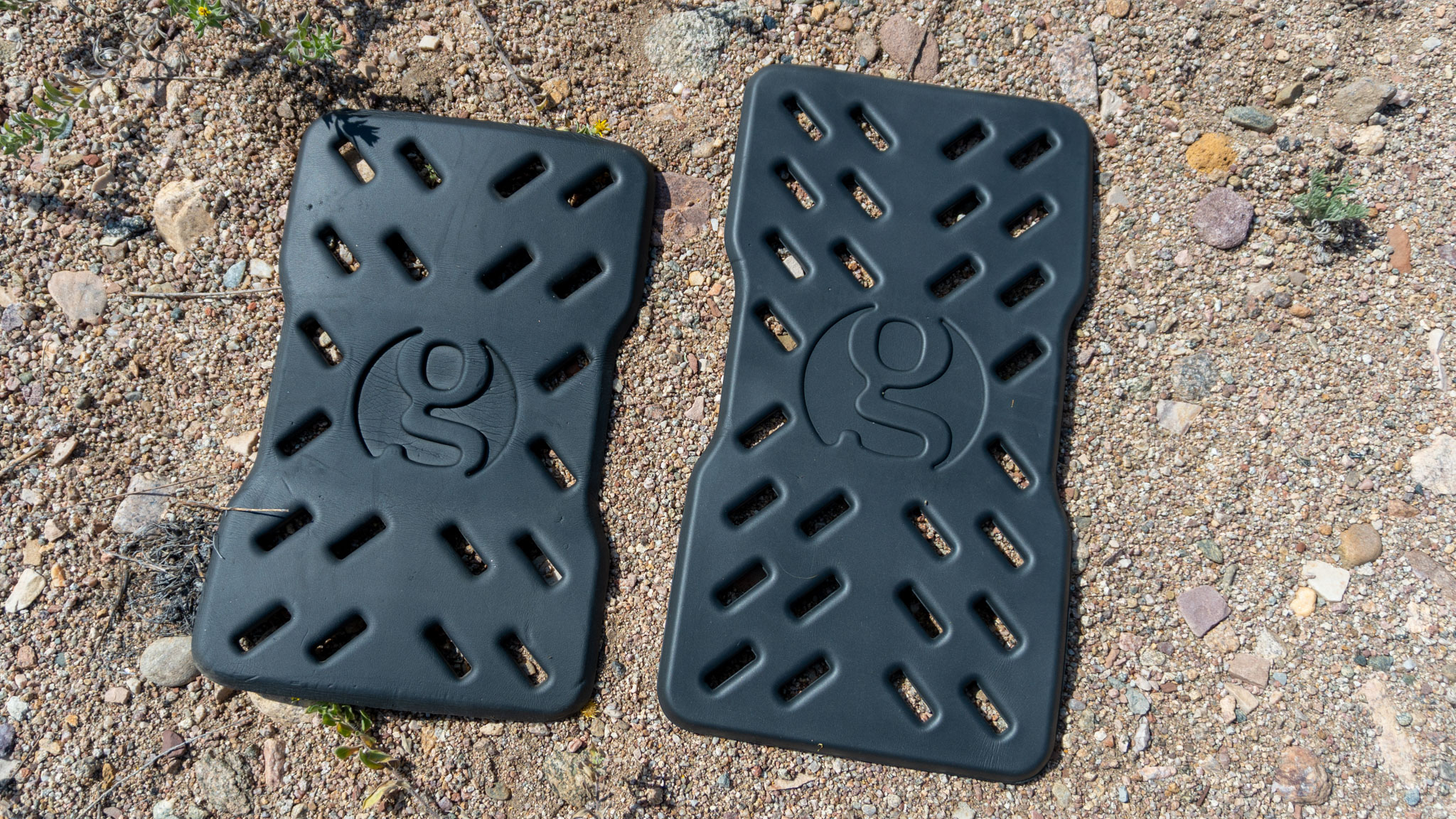
The only thing I find perplexing about the back pad that does come with the Grit 28 is that it’s only 17″ tall, which is shorter than the one you find in many other Gossamer Gear products. This makes sense as the Grit 28 is such a small pack, but it does mean you cannot fit a full-width closed cell foam pad in the exterior pad sleeve. In these instances, I simply stow my CCF pad inside and bend the pad so that it also sits on the bottom of my pad.
Other Design Details
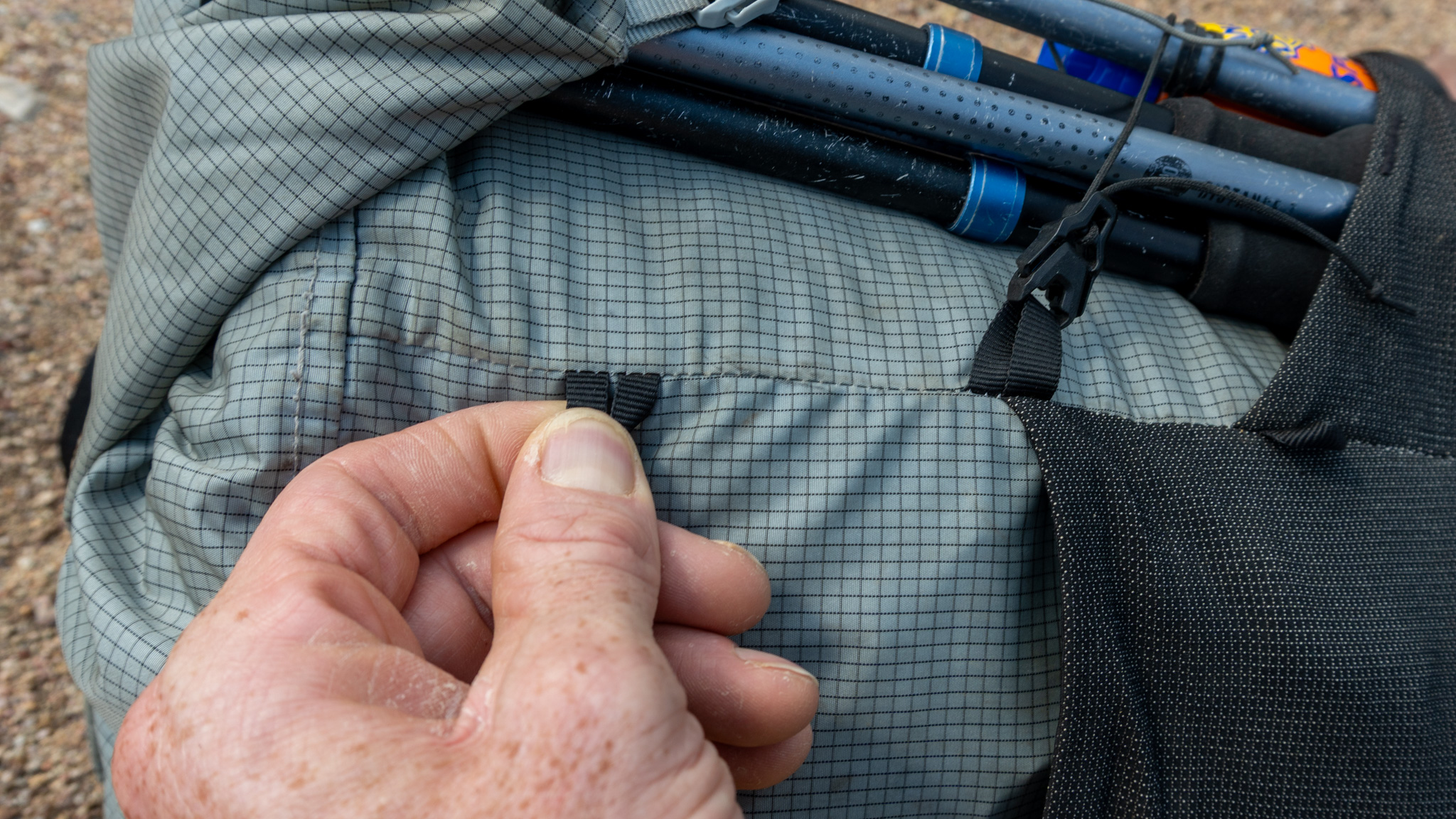
There are few other details found on the pack: a twin compression straps that run laterally on each side of the pack about the side pockets (also useful to secure tall items in the side pockets), an ice axe loop, a few small tabs that look perfect to lace your own bungee cord for more external carrying capacity, and above a small stretch cord to catch the shaft, and Gossamer Gear’s signature trekking pole holder. The trekking pole holder isn’t something I’ve used much in any of their packs and when I was looking at details to remove to save a few grams, it was on the chopping block, as was the ice axe loop. Finally In one of the front shoulder pockets, you’ll also find a small whistle and another bungee loop to keep your soft flask from jumping out.
Who is the Gossamer Gear Grit 28 Best For?
Fastpackers

If you’re base weight is sub-10lbs, fits within the 28L of storage space, and you’re looking for a pack that is comfortable for long days of cruising trails hiking with purpose and running, the Gossamer Gear 28 is your pack. When I personally went for the Collegiate Loop FKT (170 miles, 60 hours), the Grit 28 is the pack I used. When planning for an unsupported Nolan’s 14 attempt, the Grit 28 is what I’m going to be using.
Day Hikers
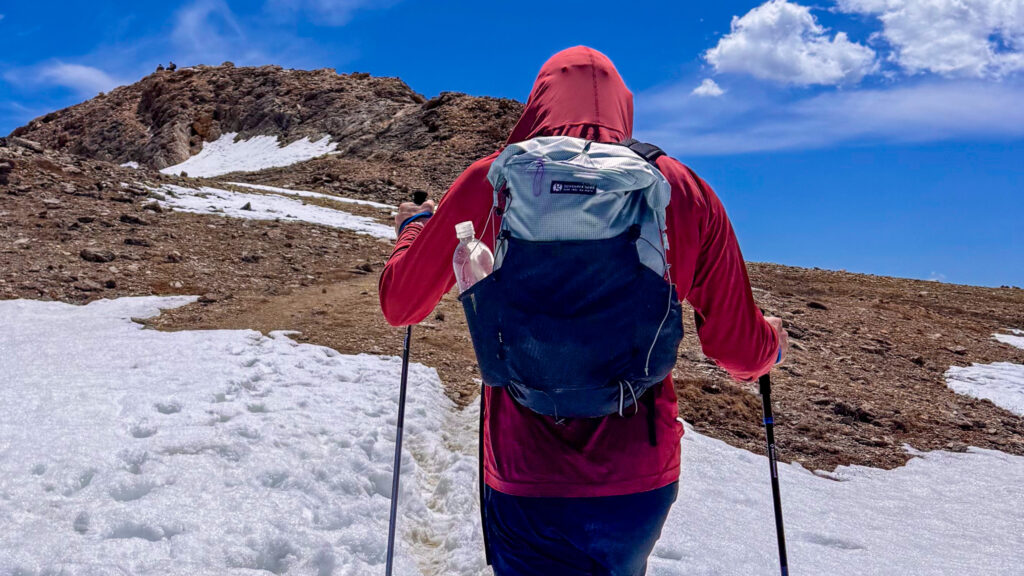
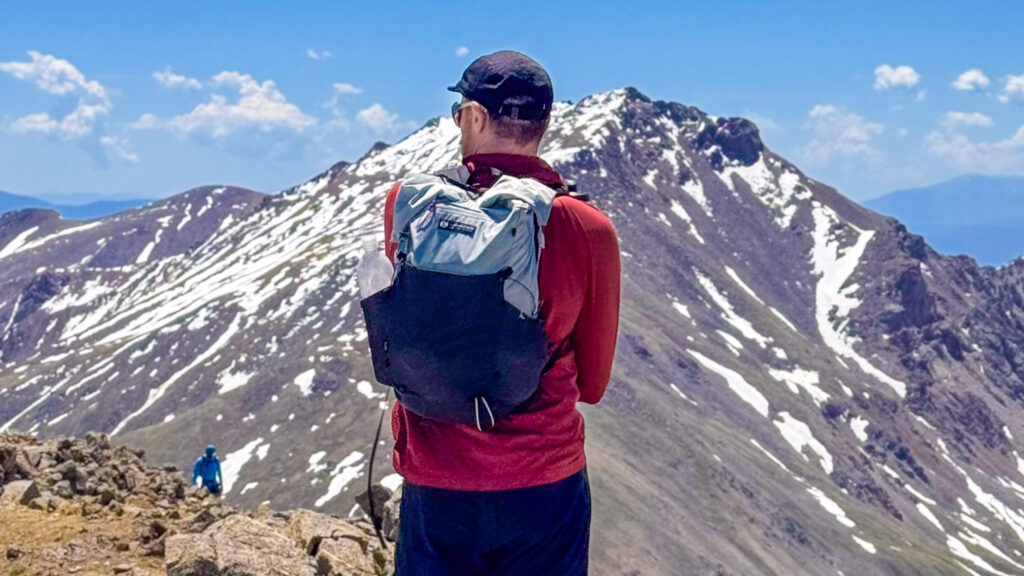
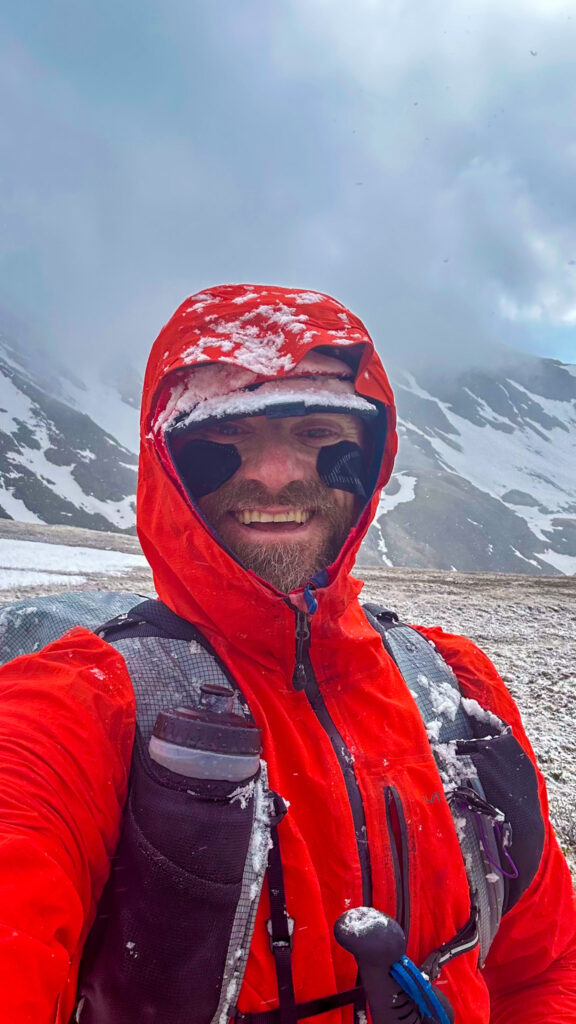
This pack is small enough and compresses down well enough to be used for day trips where you’re bringing along more than the bare minimum. Think days in the alpine where you’re bringing more layers, and/or more additional gear.
Would I Change Anything About The Gossamer Gear 28?
Bigger buckles. I have large hands, and I found the buckles too small to use quickly. Larger buckles would be easier for me to use and in the end, save me time for a small weight penalty.
The pack material. My only gripe about the pack material — which I find more than light and strong enough — is that it’s very much not water resistant. That’s the biggest tradeoff for using the 100D ripstop nylon over Challenge Ultra or a variety of Dyneema. Although this would significantly impact the price of the pack significantly, it would be nice to have alt. materials as an option.
Sizing options. It’s interesting that Gossamer Gear only released this pack in one size. I would have at least liked to try one size larger to accommodate shoulder width, as I have fairly broad shoulders to see if this pack would fit better. Pack height is less of an issue, as this pack isn’t meant to be used with a weight bearing hip belt and thus getting the height correct isn’t an issue.
A larger zippered pocket up front. I found the zippered pocket design interesting, as it’s somewhat divorced from the open, water bottle/flask pocket that it’s in front of. I was hoping that I could bring along two bottles up front, and still hold my phone in this zippered pocket, but it’s just too small for me to easily pop it in. I’d also op for two of these zippered pockets, one on each side. The right side’s open pocket is just too small when using a bottle for most anything except wrappers.
What Other Gossamer Gear Products Should You Check Out?
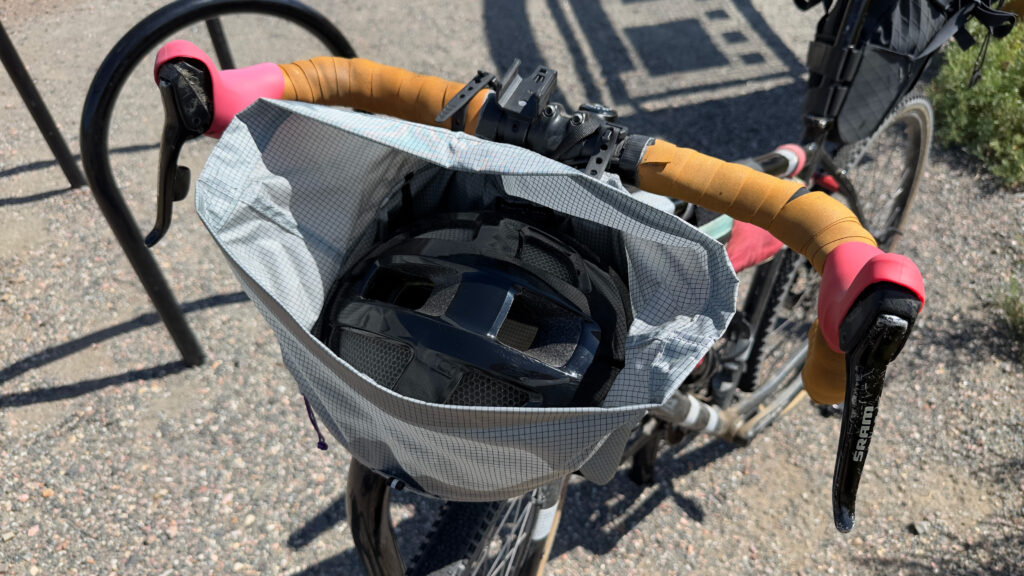
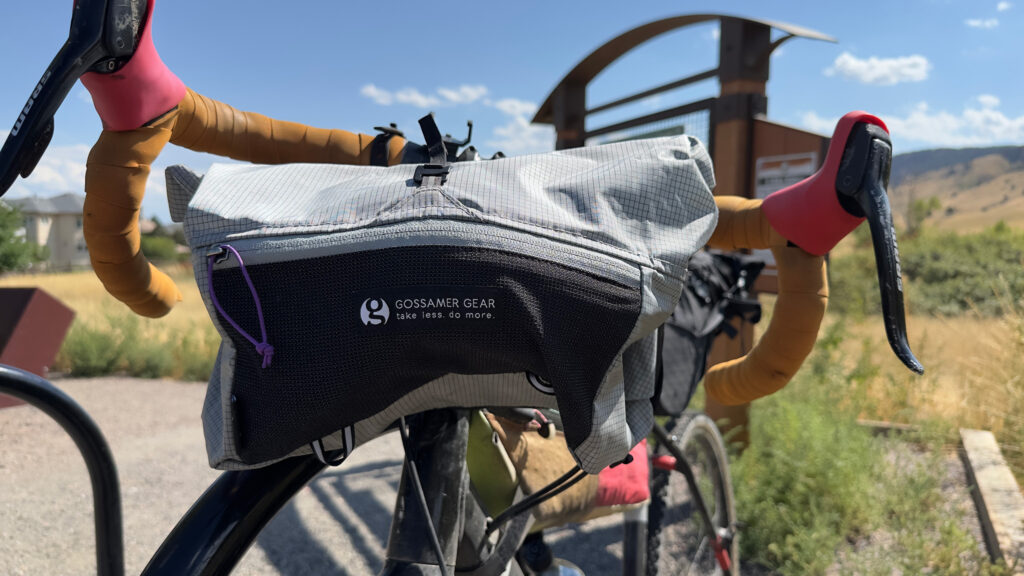
Gossamer Gear now has out a whole “Type II Collection“, which uses many of the same design language and pack material as the Grit 28. If the Grit 28 seems too small for you, consider the Skala 38, which has more internal space and a hip strap (not weight bearing) with more storage pockets. You do lose a few of the vest pockets. Grit too big? There’s the Cima 15. Lastly, there is the Piku Sling, which I’ve been using as a handlebar bag on my gravel bike all summer. I find the Piku useful for keeping my helmet — or even my running shoes — stowed while the bike is at the trailhead.
Gossamer Gear has been in the ultralight gear business more than most, and they have a ton of gear to support you when using the Grit 28. I also use their Torso Foam Pad, which I think is one of the best sleeping pad options specifically for fastpacking, being a very lightweight, “only what you need” option to pack if all you’re doing is snoozing on your route for a few winks. This option would be masochistic for a thru-hike, but if you’re going for a fast time, the 80 gram total weight is better than most any other option I’ve found.
When using it with the Grit 28, I take out its own back padding and place the Torso Foam Pad at the back of the pack, bending it down so it covers the bottom as well. Losing the back padding of the Grit 28 removes ~64 grams from the pack, so using the Torso Foam Pad only adds 16 grams total to my base weight. Considering my blow up pad weighs 522 grams, this is an excellent weight savings for the application of fastpacking.
If that’s too extreme, their very thin and ultralight Thinlite Foam Pad is useful for more scenarios than setting FKTS. Although some people use it as their only sleeping pad, you can also supplement your current blow up pad to add just a little bit more insulation, as well as getting some serious protection from sharp objects on the ground. I used the Thinlite for my 2024 Colorado Trail Unsupported FKT attempt, as a back padding in my frameless, padless pack, as well as to extend my cut down pad so that my poor feet had something soft to rest upon.
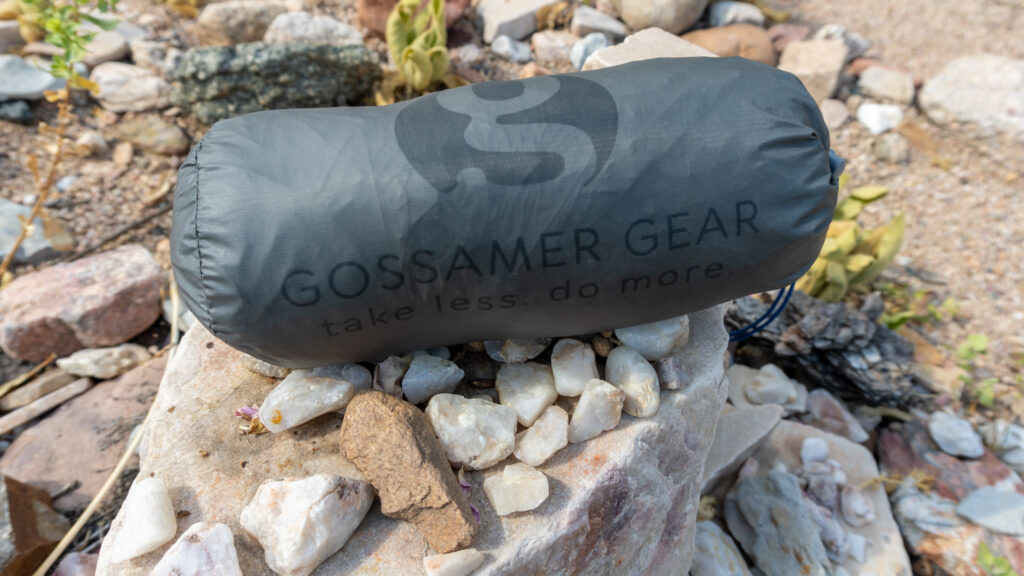
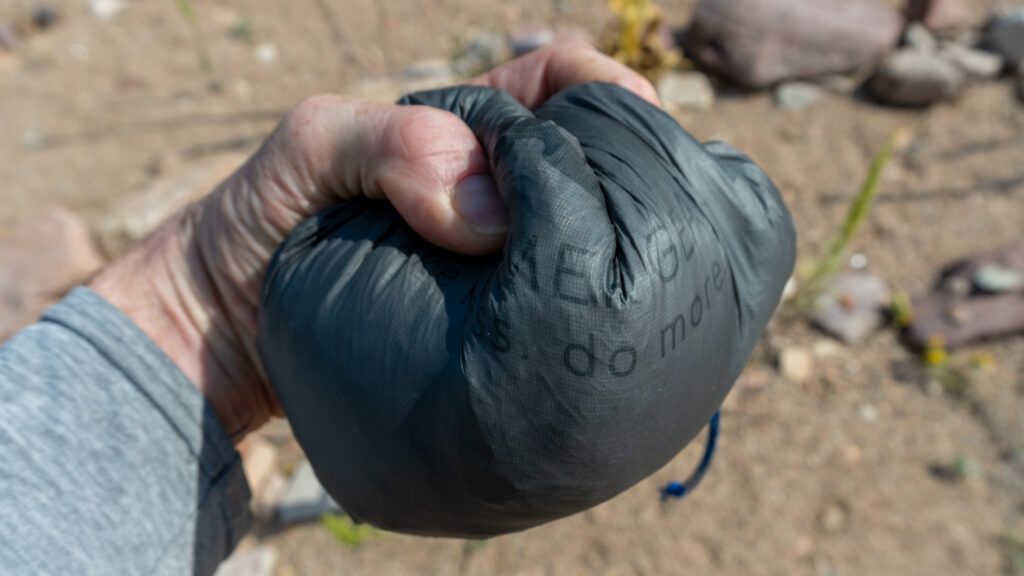
Gossamer Gear also has great shelters for fastpacking. Their Solo Tarp weighs in at a scant ~200 grams, and provides just enough shelter for one. This tarp found itself in my 2024 CT unsupported attempt as well, I especially liked how tiny it packed down — basically the size of my fist. Bringing 10 days of food meant pack space was at a major premium.
Why Listen To Me?
I’ve been competing in ultralight, ultra endurance events since my 2011 Tour Divide, and since then I have been bikepacking and fastpacking all across Colorado, most notably on my Tour 14er and Tour of the Highest Hundred odysseys. See my past fastpacking adventures and check out some of the FKTs I’ve set. When not competing, I’ve been sharing my love and passion of going ultralight with free guides to help you with your own Nolan’s 14/Slowlans adventure, as well as discovering the Sangre de Cristo Range Traverse.
For this review, along with countless road runs, commutes, grocery runs, gym sessions on the treadmill and stairmaster (ugh: don’t even ask), I’ve used the Grit 28 up in the high country of Colorado as I train and challenge myself for my own Colorado Trail, Nolan’s 14 FKTs and beyond. I’ve shared 100’s of hours with the Grit 28 sweating and losing lean muscle tissue to form the opinions I have made about this pack. It’s been my absolute pleasure. Here are but a few all-day and fastpack trips I’ve taken the Grit 28 on this summer:
- Belford and Missouri Nolan’s 14 recon
- 45 mile training day on the Colorado Trail
- 60+ mile training day on the Colorado Trail
- Unsupported Collegiate Loop Attempt
- Nolan’s 14 Recon of Columbia/Harvard, and Oxford/Belford/Missouri/Huron
- 45 mile Shavano/Tabeguache/Antero/Princeton Loop and Nolan’s 14 recon
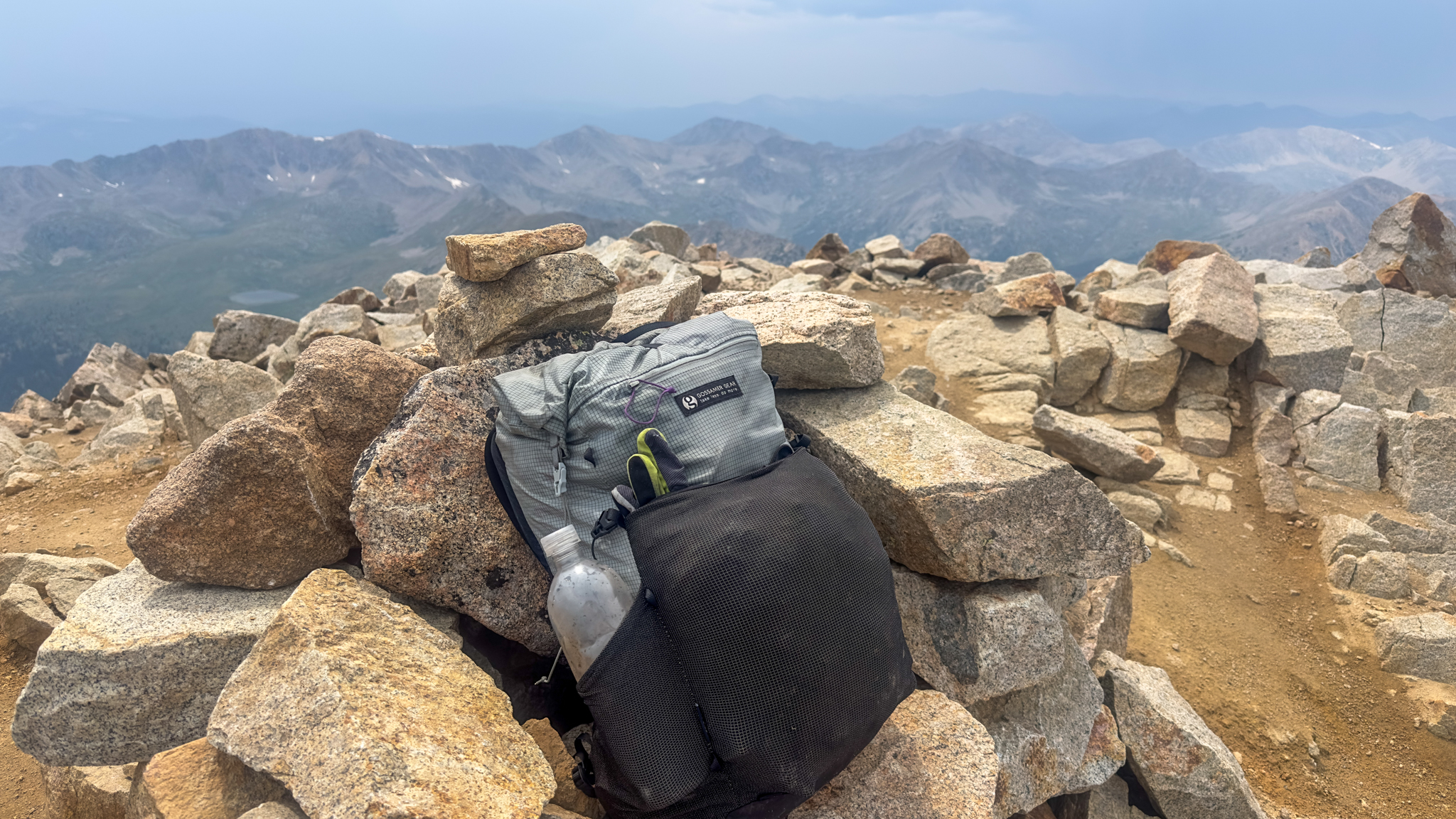
Thanks for Gossamer Gear for providing for providing the Grit 28 for evaluation. If you would like to see your product showcased on this site and on my Youtube channel, please contact me.