

Like this? Follow me:
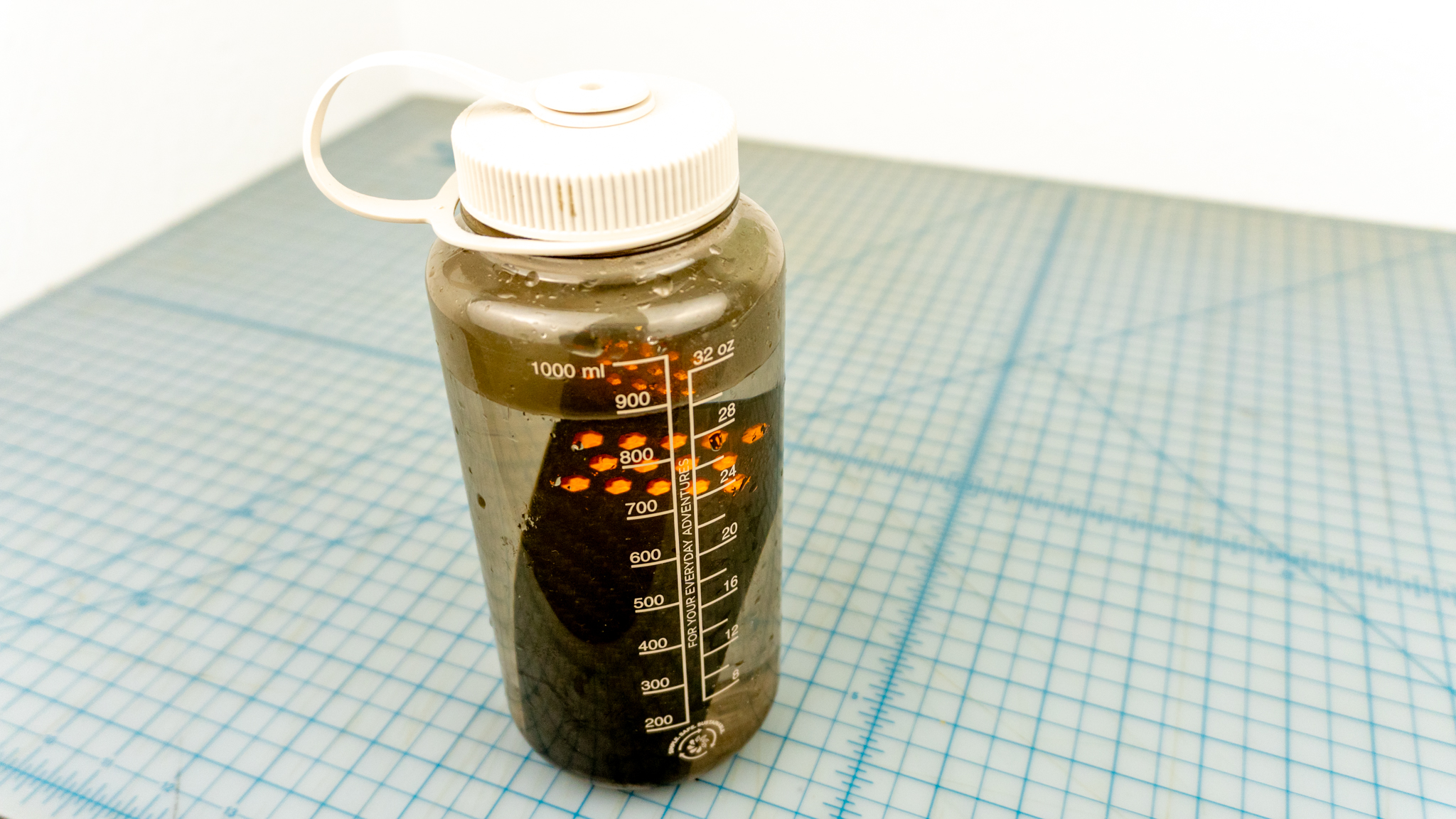
Nitecore has recently released a new version of their Carbo power bank, the Nitecore Carbo 10000 Gen2. What’s Carbo all about? As someone who spends time in the mountains in adverse conditions, for me it’s all about its IPX8 rating. This translates to a high level of water resistance: being able to be submerged up to two meters of water as per NiteCore’s marketing material. That hopefully also means it can live inside my sometimes wet backpack without blinking, and be taken out of more safer places while it’s raining and snowing around me.
They also advertise that the Carbo 10000 Gen2 can take a drop of 1.5 meters. Impressive. This is accomplished at least in part by utilizing a much more impermeable yet still lightweight carbon fiber shell, as well as a touch-sensitive button, rather than being mechanical.
I’ve used the Carbo 10000 Gen2 myself for day-to-day use, bringing it along to work, on my bike rides, hikes, and runs without any noticeable problems. I’ve casually dunked it into water and kept it in there for a few minutes without ill effect (as the hero image will attest). In the future, I’ll take it on a longer backpacking trips with a few overnights soon where I’ll stress test it further. The promise of a power bank I can have more trust in not failing from being abused in less than perfect conditions is a compelling one.
Note that the power bank is rated to be submerged in water, but it is NOT rated nor advertised to be used while at all wet!
Along with this day-to-day use, I have performed some simple lab tests to explore some of its charging claims. And since I own Nitecore’s NB 10000 Gen3, I can compare the two. The big difference between the two is that the NB 10000 Gen3 is marginally lighter, but lacks many of the water resistance and impact resistance claims.
Even though the NB Gen3 and Carbo Gen2 are marketing as having the same mAh, there are probably some marginally technology improvements that could make the Carbo Gen2 perform better, which I’ll explore in detail below. mAh – even for such similar products – is a slightly problematic metric to use for energy capacity. To understand why, see my post about choosing a power bank and how best to do that. I’ll be preferring Watt hours (Wh) in this post instead.
Weight
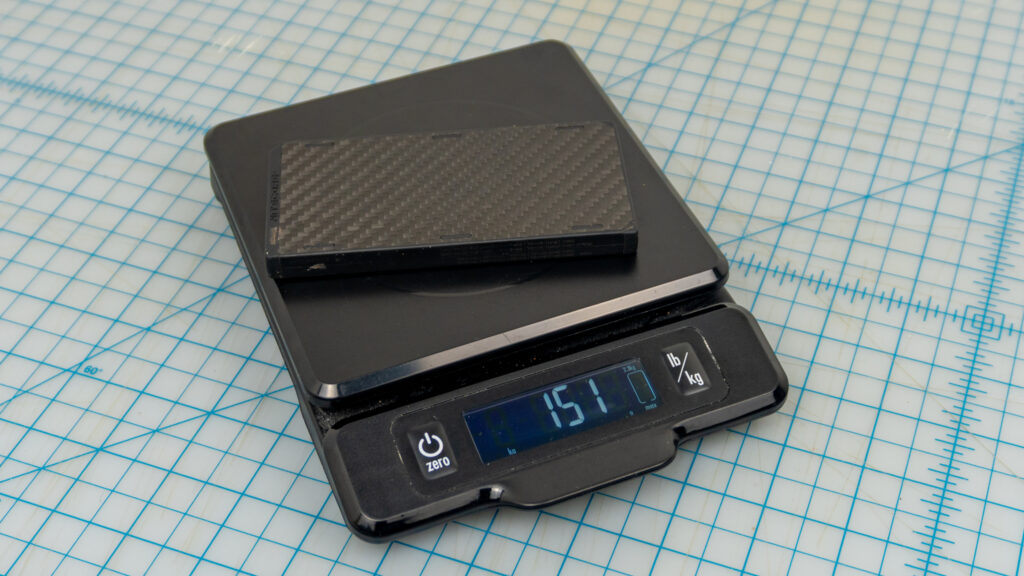
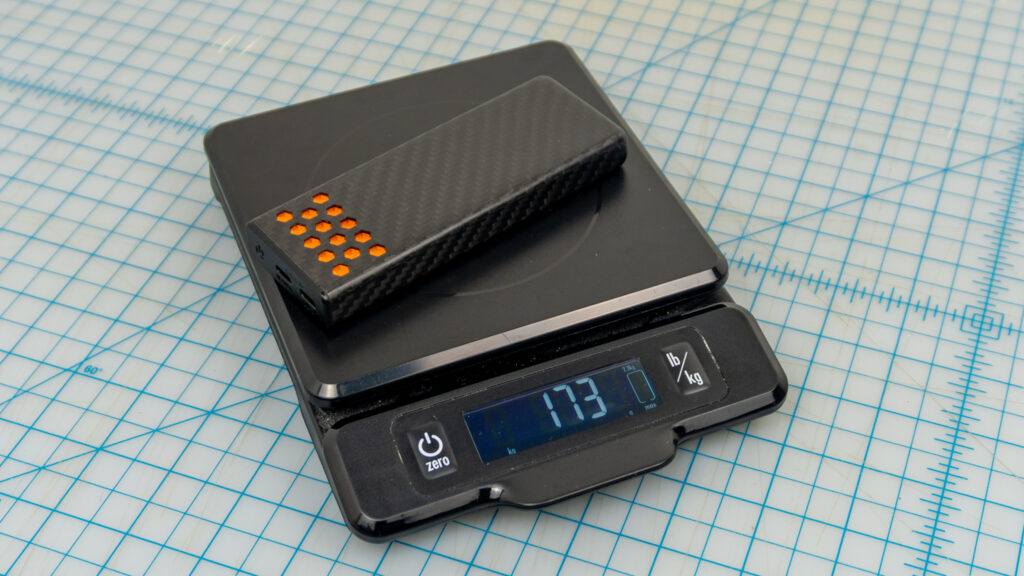
Since I’m very interested in weight of all my gear (as a human-powered athlete that has to carry all my gear), I first weighed the two power banks, with the NB 10000 Gen3 coming in at ~151 grams, and the Carbo 10000 Gen2 coming in at ~173 grams. For absolute weight weenies, the NB 10000 Gen3 is the power bank to pick between the two. But what is the energy capacity difference between the two power banks?
Energy Capacity
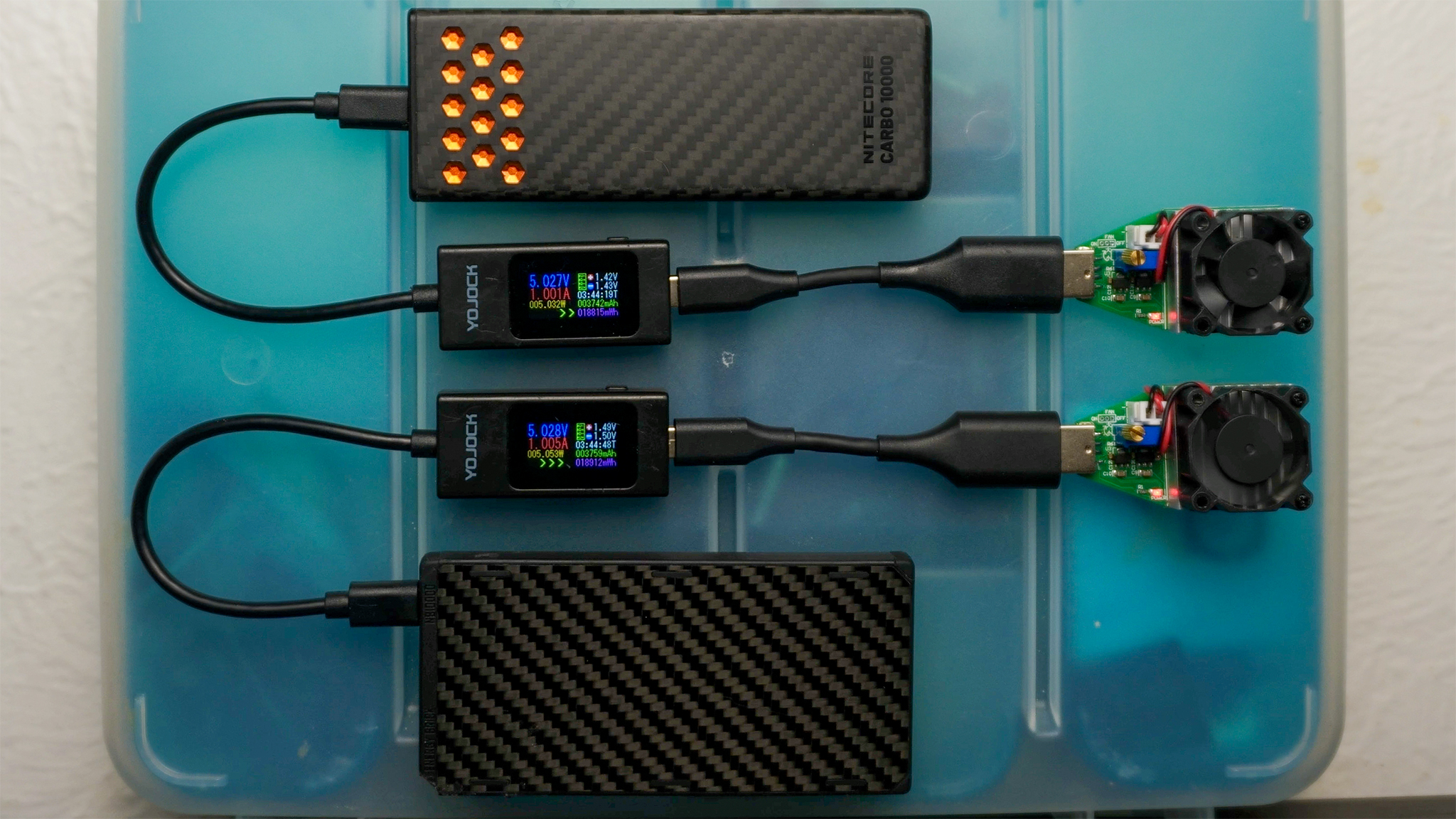
Energy Capacity can be tested using a simple discharge test using a dummy load and an inline USB power meter. My test load was 5 Watts (5V, 1A), a fairly easy load for these power banks to handle. Because of real-world inefficiencies, actual capacity is always going to be lower than advertised:
| Rated Capacity (mAh / Wh) | Tested Capacity (mAh / Wh) | Tested Wh/gram | |
| NB 10000 Gen3 | 10,000 mAh / 38.5Wh | 6961 mAh / 35.007 Wh | 0.233 Wh/gram |
| Carbo 10000 Gen2 | 10,000 mAh / 38.8Wh | 7160 mAh / 35.987 Wh | 0.212 Wh/gram |
The NB 10000 Gen3 is marginally lighter, but does show less actual power capacity when compared to the Carbo 10000 Gen2 by a little under 1Wh. But gram for gram, the NB 10000 Gen3 holds more capacity for its weight by a very slim 0.021 Wh/gram.
Recharging Speed
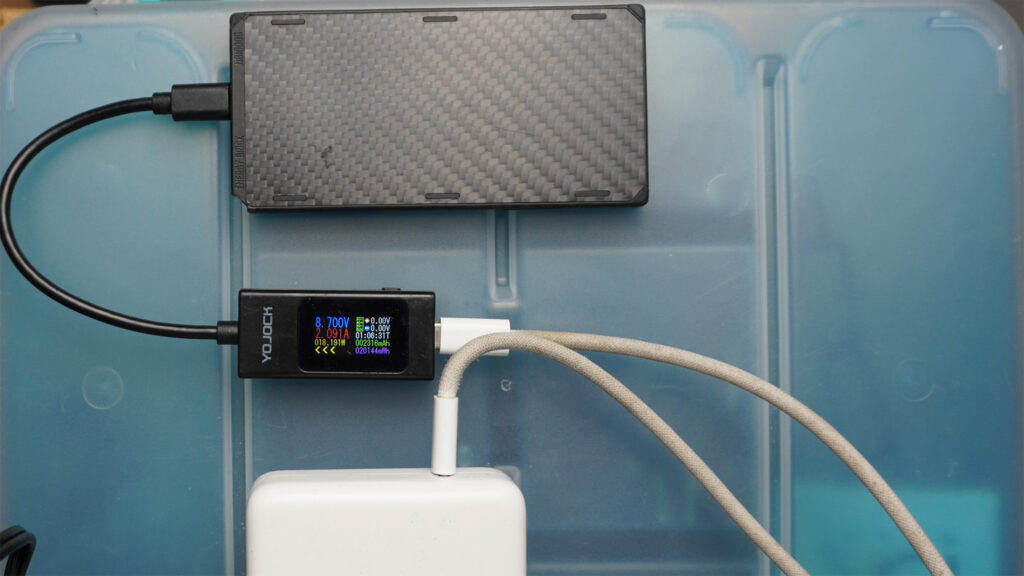

Recharge ratings between the two power banks varies significantly, with the older NB 10000 Gen3 having a max recharge rate of 18W, and the newer Carbo 10000 Gen2 having a max recharge rate of 24W. I tested this by using my M1 Macbook Pro’s power adapter as my power source, which should provide very high quality charge that far exceeds either of these power banks in both current and voltage.
Results showed that both power banks met and actually slightly exceeded their respected rated max recharge rates, but this rate isn’t endured forever, which is a result that would be expected. The NB 10000 Gen3 drops off below 18W after 1hr 36min and fully recharges after 3hr 16min.
Similarly, the Carbo 10000 Gen2 drops off below 24W after 1hr 11min, and fully recharges after 2hr 28min. We can then conclude that with a good quality power source, the Carbo 10000 Gen2 will fully recharge faster by 48 minutes compared to the NB 10000 Gen3.
Maximum Output Charging Rate
The Carbo 10000 Gen2 is rated to be able to charge at a maximum of 30 Watts, a fairly substantial gain over the NB 10000 Gen3, which is only rated at 22.5 Watts. As is true with recharging, you’ll want to make sure that you have a high quality charging cable that supports this charging rate, as well as a device that desires it. I used my Macbook as a stand-in for a high powered device. Note: although my Macbook will draw power from these power banks, neither power bank is going to be realistic to be used as a power source for too long, as these power banks cannot sustain the current that my Macbook craves)
Results were pretty much as expected, with the older NB 10000 Gen3 showing an actual maximum charging rate of 19W, and the new Carbo 10000 Gen 2 showing an actual maximum charging rate of 28.65W.
| Advertised Max Charging Rate | Tested Max Charging Rate | Difference | |
| NB 10000 Gen3 | 22.5 W | 19W | 3.5W |
| Carbo 10000 Gen2 | 30 W | 28.65W | 1.35W |
Max Output Charging Rate with Two Connected Devices
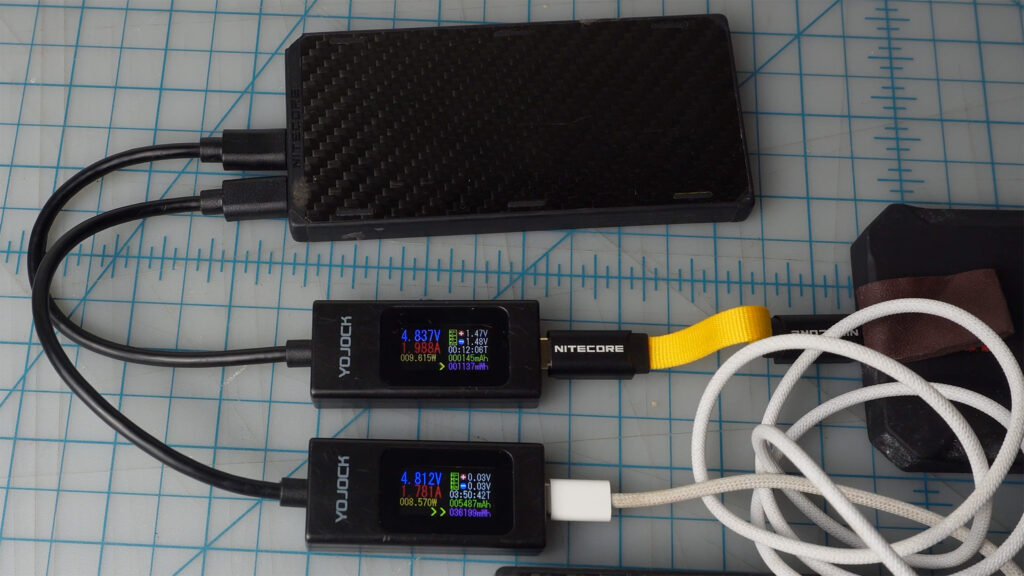
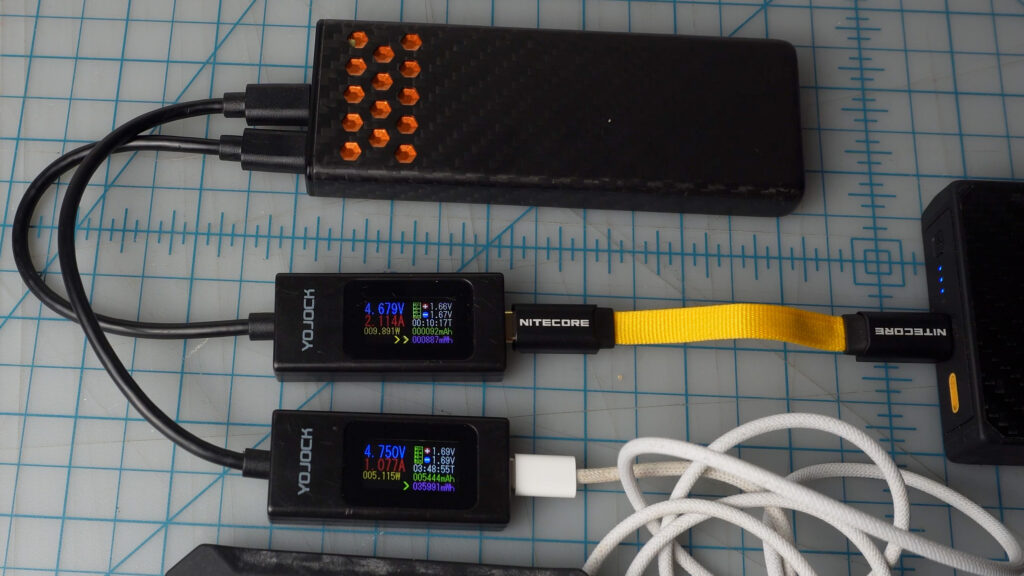
Both of these powerbanks have two USB-C outputs, with both the NB’s pulling double-duty as inputs, while the Carbo curiously only supports one of the USB-C ports for input. This is a slight usability detail, as you’ll need to make sure you plug in your cable into the right port to charge! (ports are labeled).
Max output does go down when two devices are connected for each power bank.
The NB 10000 Gen3 shows a maximum output of 18W (15W advertised) when two devices are connected, while the Carbo 10000 Gen2 shows a maximum output of only 15W (15W advertised) with two devices. I’m not sure why the NB shows such better numbers than advertised, but I couldn’t improve upon the Carbo’s performance, no matter the various cables/charging devices (madness easily can consume one in these types of tests). I invite any and all criticisms of this test and all the others — please leave a comment or send me a message of tempered anger.
Pass-Through Charging Support
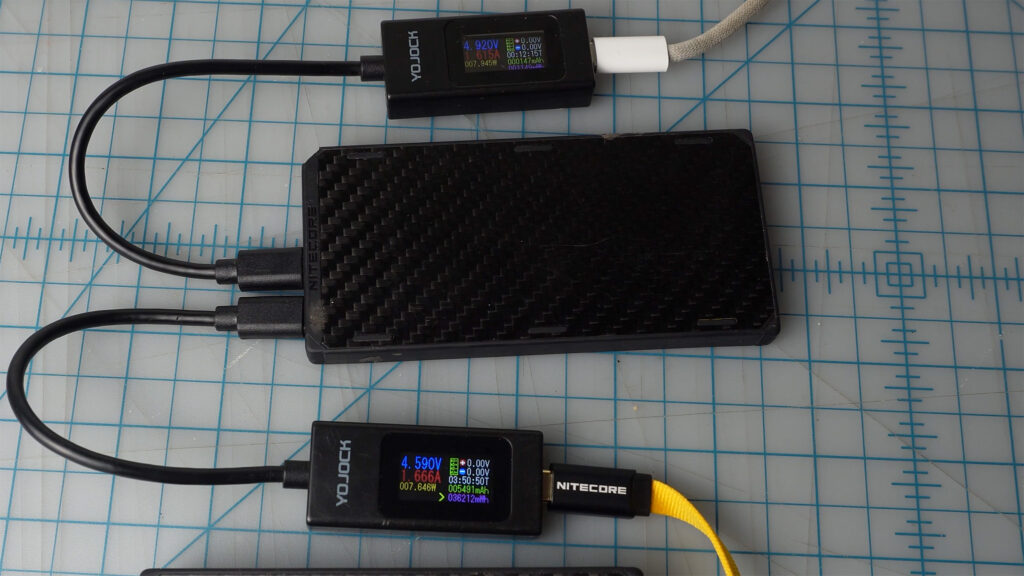
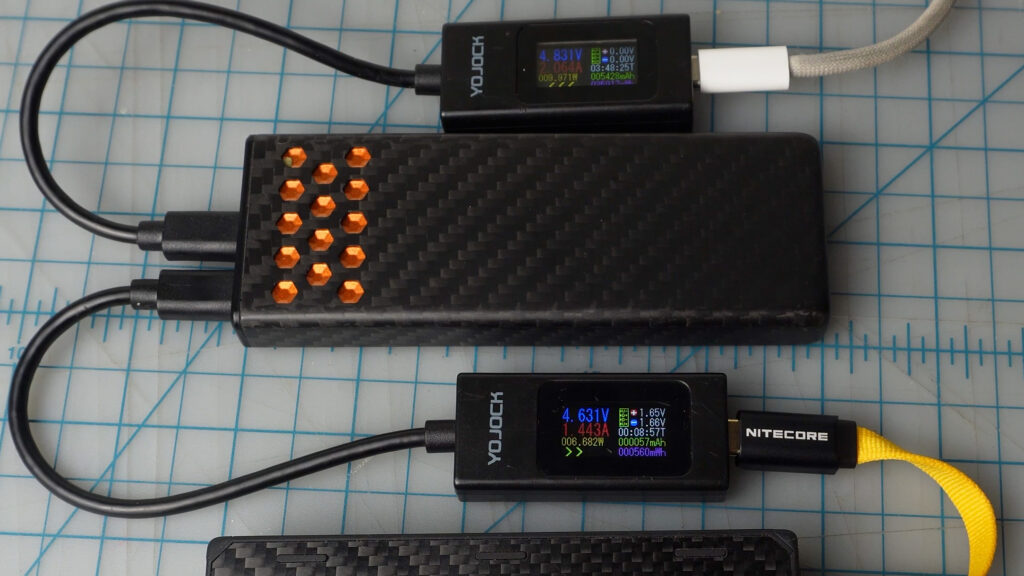
Although not explicitly mentioned in the manual, it does seem that the Carbo 10000 Gen2 supports pass-through charging! The NB 10000 Gen3 does as well. And as expected, for both power banks, charging rate of the power bank and charging rate from the power bank are lower – much lower – than if the power banks were doing either task separately. This is a detail worth paying attention to, especially if you’re trying to share a crowded recharge station during a brief stopover in town when backpacking through. Don’t expect anywhere near the maximum recharging speed when taking advantage of pass-through charging capabilities.
The NB 10000 Gen3 illustrated a combined total input/output rate of ~15.6W with pass-through charging, roughly equal between input and output.
The Carbo 10000 Gen2 illustrate a combined total input/output rate of ~16.7W with pass-through charging: approx 10W coming in to charge the power bank itself, and approx 6.7W to charge the device attached to the power bank.
This is huge dropoff in performance of both power banks, leading me to opine that pass-through charging is kind of a cool trick, but real-world performance leaves something to be desired. I’m not sophisticated enough to understand the difference in performance between the two, but the Carbo 10000 Gen2 does show marginally better pass-through recharging performance over the NB 10000 Gen3.
Low Current Mode
Neither of these power banks advertised a “low current mode” for charging electronics that don’t need much current, although the older NB 10000 Gen2 does. It’s unclear to me if either power banks are sophisticated enough to just not need this to be explicitly set. But such a lower current mode leads to problems if the user forgets to switch it off.
Regardless, both the power banks charged my extremely inexpensive (and probably pretty primitive when it comes to power management) low-powered Bluetooth ear buds without blowing anything up, so I’m going to say it passes at least half of this test.
What I haven’t tested is if leaving the Bluetooth earbuds plugged in to recharge will still draw a small charge and thus drain the power banks over a very long time as is feared by some users who are too careful to try leaving such a device plugged in overnight. Since I haven’t tested this, I won’t comment on if this is a problem or not, but I do apologize for adding yet another thing to be anxious about in your day-to-day life.
Should you purchase the Carbo 10000 Gen2 over the NB 10000 Gen3? Which power bank is better?
The added durability of the Carbo 10000 Gen2 is appealing, especially for someone so accident-prone as myself. Further in-the-field testing would have to be done to see if the marginal weight gain over the NB 10000 Gen3 is worth the piece of mind it should garner you.
Price
Cost differences of both need to be mentioned. The NB 10000 Gen3 is currently being sold at $64.95, both at Amazon as well as at the US Nitecore store, whereas the Carbo 10000 Gen2 is being sold for almost twice as much: $119.95 on Amazon as well as at the US Nitecore store! The Carbo series has always been sold at a higher price than their NB brethren, but the comparitve increase in price has widened. Not to be too political, but this increase in price may be in part explained by new tariffs being imposed by the US over China. There very soon could be a price adjustment coming for many products from Nitecore and others. I’ll attempt to update this part of the review if/when reality shifts again.
Thanks for reading.
And thanks for Nitecore for providing the Carbo 10000 Gen2 for evaluation. If you would like to see your product showcased on this site and on my Youtube channel, please contact me.